


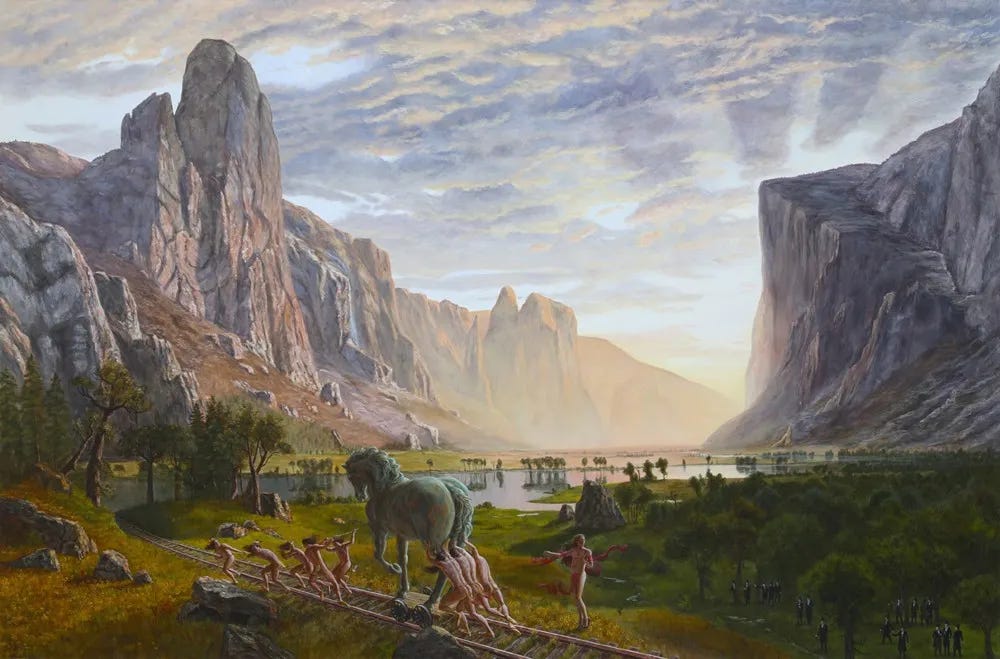
Israel Powell was a bad dude. He was BC’s first Superintendent of Indian Affairs, an assimilationist, a supporter of BC’s residential school system, and a notorious thief of Indigenous ceremonial and sacred belongings.
At least among history nerds, that’s all well known. But few people know that he also wheeled and dealed in real estate while serving in public office. It wasn’t always above board. Specifically, he colluded with a corrupt politician from Winnipeg to deceive the public about where the Canadian Pacific Railway would build its terminus station, sneakily buying up huge chunks of what would become the city of Vancouver while everyone else thought the railway would end in Port Moody. By the time the first train reached Vancouver, Powell was one of the largest land-owners in the city.
There’s two things I find interesting about Powell’s shady dealings:
From its earliest days, British Columbia was structured to appropriate Indigenous lands and enrich a small handful of wealthy land-owning elites. Few examples are more illustrative than Israel Powell - a guy who, while serving as the Provincial agent responsible for the dispossession of Indigenous lands, got wildly rich by claiming those same lands for himself.
Today, Powell’s swashbuckling era of real estate speculation is making a comeback. Our new provincial government loudly campaigned on a promise to repeal the Declaration on the Rights of Indigenous Peoples Act and defend private property, while quietly cutting taxes for developers and revoking the previous government’s affordable housing protections.1
I’m not the only one making the connection. Premier-designate Lorne Doerkson himself, in his recent victory speech, made his revival of gold-rush era politics explicit:
“British Columbians are hard-working, trailblazing people. They want a fair shot at building something in this province. And that is the oldest story in this province.
First Nations built lives and nations here for thousands of years, and then came people who walked into the Cariboo with the clothes on their backs and a dream. They carved a wagon road up the Fraser Canyon to get to the goal, and plenty of them went broke. Plenty of those camps are ghost towns today, but they went anyway for a chance to build something amazing.
That is the trailblazing spirit of British Columbia, and it never left. It just needs government that’s on its side.”
Powell was a trailblazer
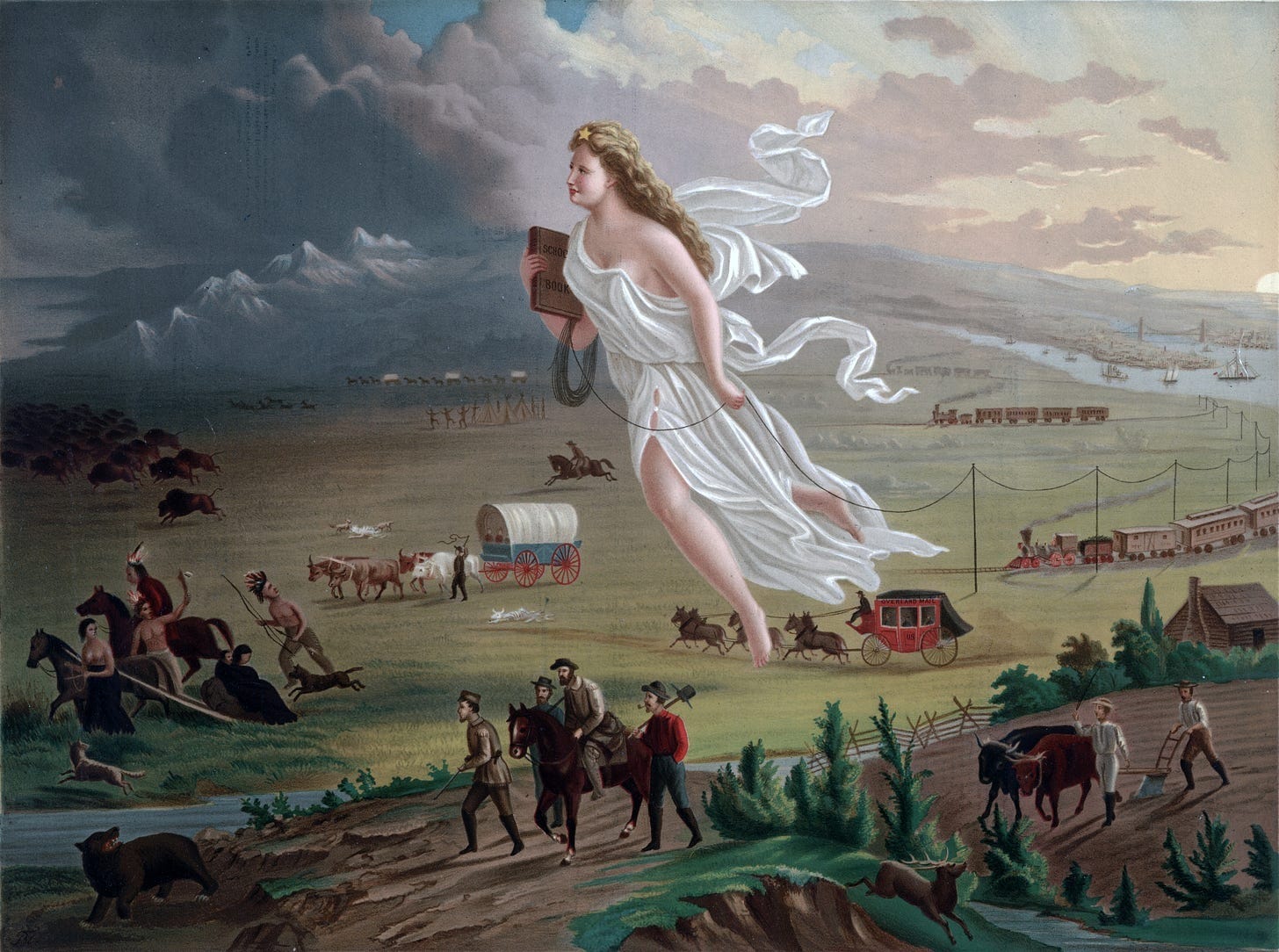
An adventurous young man, at twenty-six Powell left his home in Ontario and travelled across the continent to the BC coast to take part in the Cariboo gold rush (the same one that Doerkson referenced in his victory speech).
But, the son of a powerful shipping magnate and eastern politician, Powell wasn’t destined for the rugged canyons of the Cariboo. Instead, when Powell arrived in Victoria, the British Colonist pumped his tires, reporting that he “brings very high testimonials from Canada, which speak in the most favourable terms of him.” By 1863 (less than a year after his arrival on the coast), he was elected to the House of Assembly of Vancouver Island.
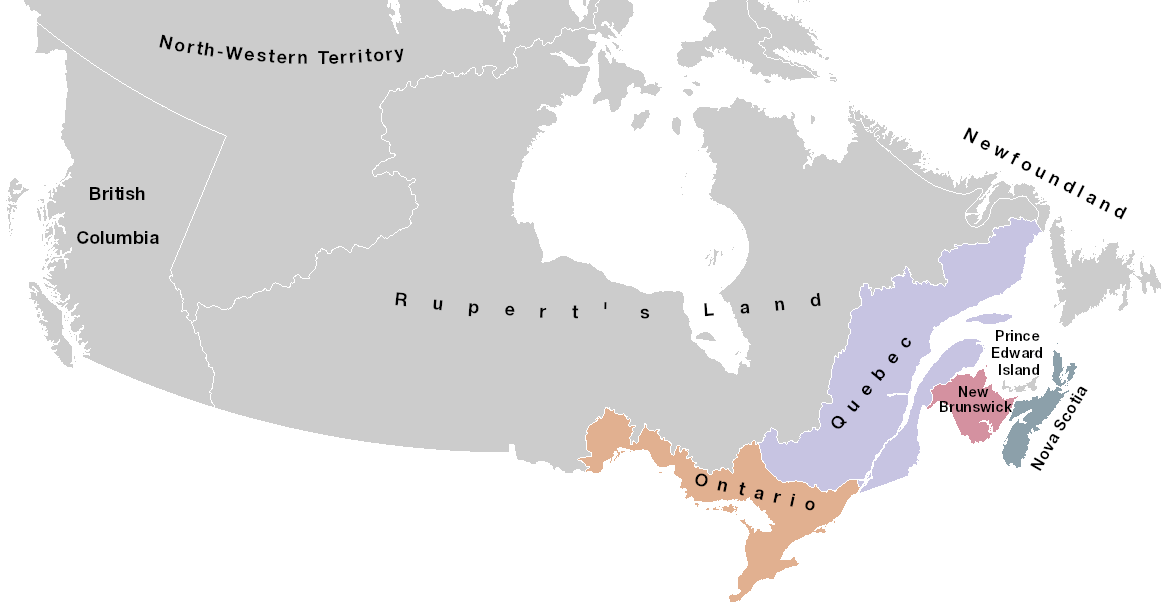
During his tenure, British Columbia hadn’t yet joined Confederation. It was still a British colony, separated from Canada by Rupert’s Land, a massive territory that was British in name only. In practice, it was an Indigenous-governed territory that few settlers knew.
To tempt the Colony of British Columbia into Confederation, John A. MacDonald (Canada’s first Prime Minister and friend of Powell’s dad) promised to build a railway across Rupert’s Land and connect the Pacific coast to the Eastern Provinces. Most people in Victoria were skeptical of MacDonald’s ambitious promise and wary of conceding power to a distant government in Ottawa. Still, Powell continued to champion the idea, an unpopular position that cost him re-election in 1868.
By 1871, political tides shifted (for reasons that we won’t get into) and BC joined Canada. In reward for his loyalty, MacDonald appointed Powell as BC’s first Superintendent of Indian Affairs.
MacDonald made good on his promise, and work on the Canadian Pacific Railway (CPR) began immediately. Aside from extreme distances and hostile terrain, one of the biggest obstacles to construction was that Canada had no legal claim to the Indigenous lands the railway crossed. It was Powell’s job to help resolve this “Indian problem” and smooth the transfer of land to the Canadian government.
With large sections of the railway completed in the East, it still wasn’t clear what route the railway would take once it arrived at the mountains of BC. As late as 1877, it was thought that Bute Inlet (just north of Powell River) was “by far the most advantageous point to touch salt water” and the likely choice for the railway’s terminus.
As the CPR worked its way west, it was preceded by a frenzy of real estate speculation. Reserve Commissioner Gilbert Sproat noted that:
“several influential persons in Victoria are interested in land speculations in connection with new discoveries on Texada Island, and a possible railway terminus at Bute Inlet, and they would rather that the Indians, even at this late period in the history of the province were left out in the cold for some time longer.”
Israel Powell was one of those influential persons. As Superintendent of Indian Affairs, he intervened to delay the survey of Tla’amin territory and facilitate the illegal sale of Lot 450, a 2,775-acre timber lease immediately south of Bute Inlet. It was bought by his pal, fellow Victorian politician Robert Paterson Rithet. The site would later become the city of Powell River.
Powell goes whole hog
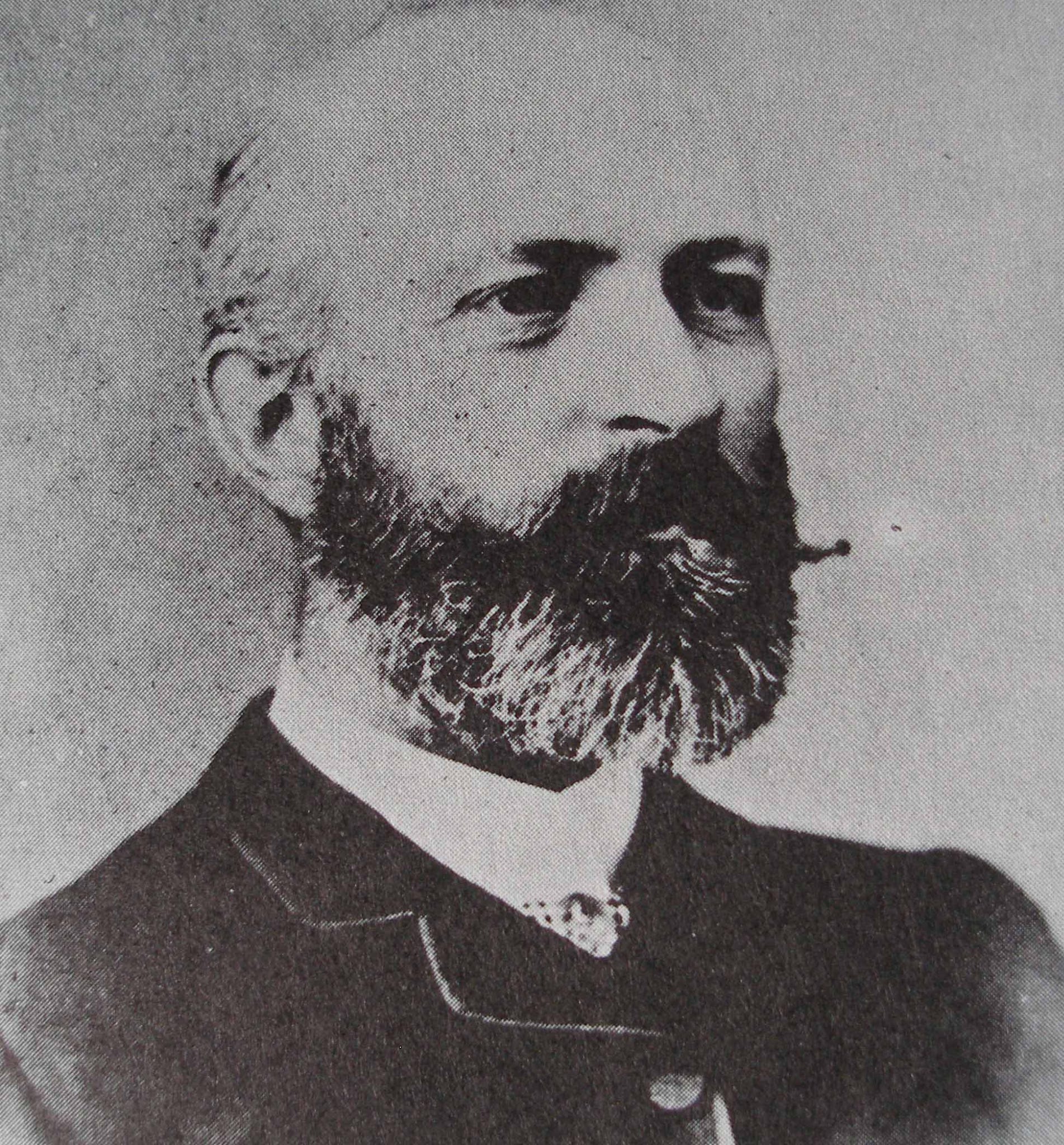
Powell first dipped his toes in real estate speculation on his friend’s behalf at the expense of the Tla’amin people, but it would still be a few years until he’d go whole hog and commit his considerable family wealth to buying up land of his own.
Back in 1869, the Provincial government had confined the Sḵwx̱wú7mesh to a thirty-seven-acre reserve at the mouth of False Creek. The rest of their territory was up for grabs, and Powell started scooping up land. First, a share in Vancouver’s Hastings Saw Mill (the only business of any size in Vancouver at the time). Then, in 1877, he bought nearby District Lots 182 and 183 (present-day Gastown and eponymous Powell Street). Then, through the Vancouver Improvement Company (a real estate syndicate he belonged to), he bought another 330 acres along Burrard Inlet.
Powell knew something that most people didn’t. Up until 1884, the public believed Port Moody, twenty kilometers east of Vancouver, was destined to become the railway’s Western terminus. While Powell was quietly buying up cheap land in Vancouver, Port Moody was in the midst of a speculative fever destined to collapse in disappointment and bankruptcy.
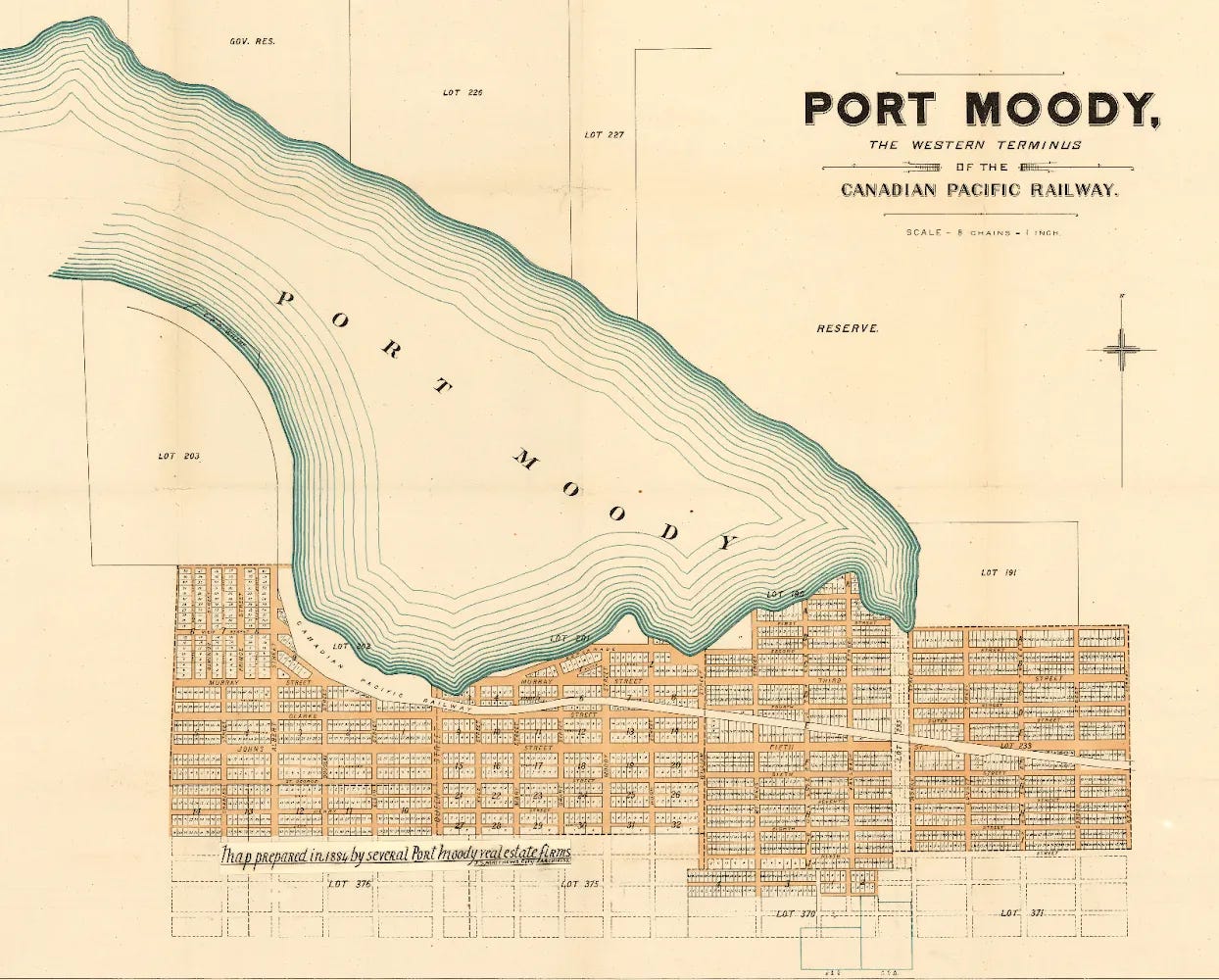
It begs the question, how did Powell know where the railway would end - years before almost anyone else?
It was all thanks to Arthur Ross - a greasy dude from Winnipeg with a gambling problem. Ross was a Member of Parliament and a freewheeling real estate man. He was briefly one of the richest men in Winnipeg but was left holding the bag when the city’s real estate bubble burst. A local paper called him a swindler engaged “in the wildest schemes of speculation.” He arrived in Victoria running from his debts, hoping to cash in on his political connections before the railway arrived on the Pacific coast.
The guy was a real character. Decades later, in an interview with a city of Vancouver archivist, a member of the Vancouver Improvement Company reminisced about Ross’ sketchy arrival on the coast:
“One day Van Horne got off the steamer from Tacoma at Victoria and A.W. Ross was with him. A sheriff tapped Ross on the shoulder as soon as he touched the wharf. It was a most awkward situation for Ross; he had come up on the boat with Van Horne and here he was under arrest as soon as he landed. Some clergyman in Australia had entrusted some funds to him for which it was said he had not accounted.”
William Van Horne, the man Ross arrived in Victoria with, was Ross’ ticket out of debt and back into elite society. A close personal friend, Van Horne also happened to be the president of the CPR.
Despite having already crossed the prairies into British Columbia, the railway still had hundreds of kilometers of treacherous terrain to cover and its completion was far from guaranteed. In exchange for Ross’ support of the CPR in Parliament, Van Horne gave Ross an invaluable letter “to the effect that the terminus was to be at Coal Harbour, not Port Moody.” Having no money of his own, Ross convinced elite members of Victoria society to invest in his scheme. In recognition of his valuable insider knowledge, they gave him a one-fifth share in the Vancouver Improvement Company, their newly formed real estate syndicate. Its membership included prominent political figures such as Major Dupont, David Oppenheimer, and our man Israel Powell.2 Together, they bought up huge chunks of land surrounding what would become the CPR station in Coal Harbour.
At the last minute, just before the railway reached the Pacific Ocean in 1885, the Provincial government granted the CPR six thousand acres of free land in Vancouver. The Vancouver Improvement Company contributed an additional one-third of their Hastings Mill property. With all the pieces in place, William Van Horne broke the news to the public that the ocean at Port Moody was too shallow for the CPR’s steamships and Vancouver would be the railway’s terminus instead.
Immediately, Vancouver property values skyrocketed - and Powell and his friends made a fortune.
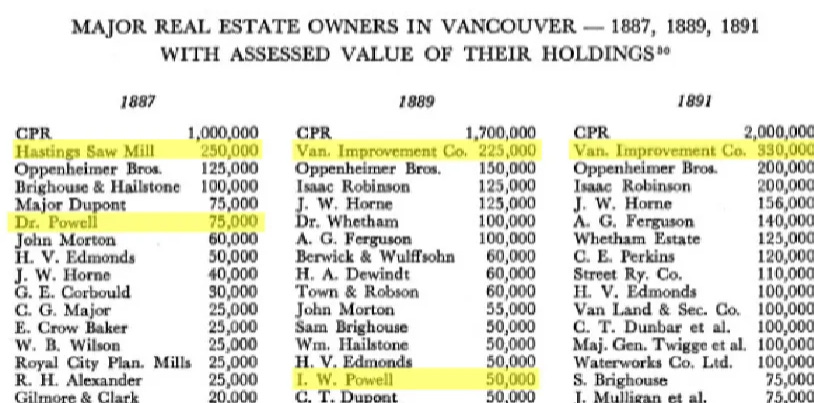
Powell and his friends learn us a lesson
“This robbing Port Moody of the terminus is beginning to rouse a spirit of rebellion, and all investors are beginning to show very ugly teeth after being assured so many times by the Government that Port Moody was the terminus, invested their little all in clearing out the wilderness and building a home; then for the Government to turn their back on us and allow a syndicate of land grabbing speculators to extend the line to English Bay.”
Port Moody Gazette, August 1, 1885
As we brace for a premier who romanticises the pioneering spirit of the gold rush, who has promised to roll out the red carpet for developers and slash protections for Indigenous rights, it’s important to ask - who benefited from those same policies in the past?
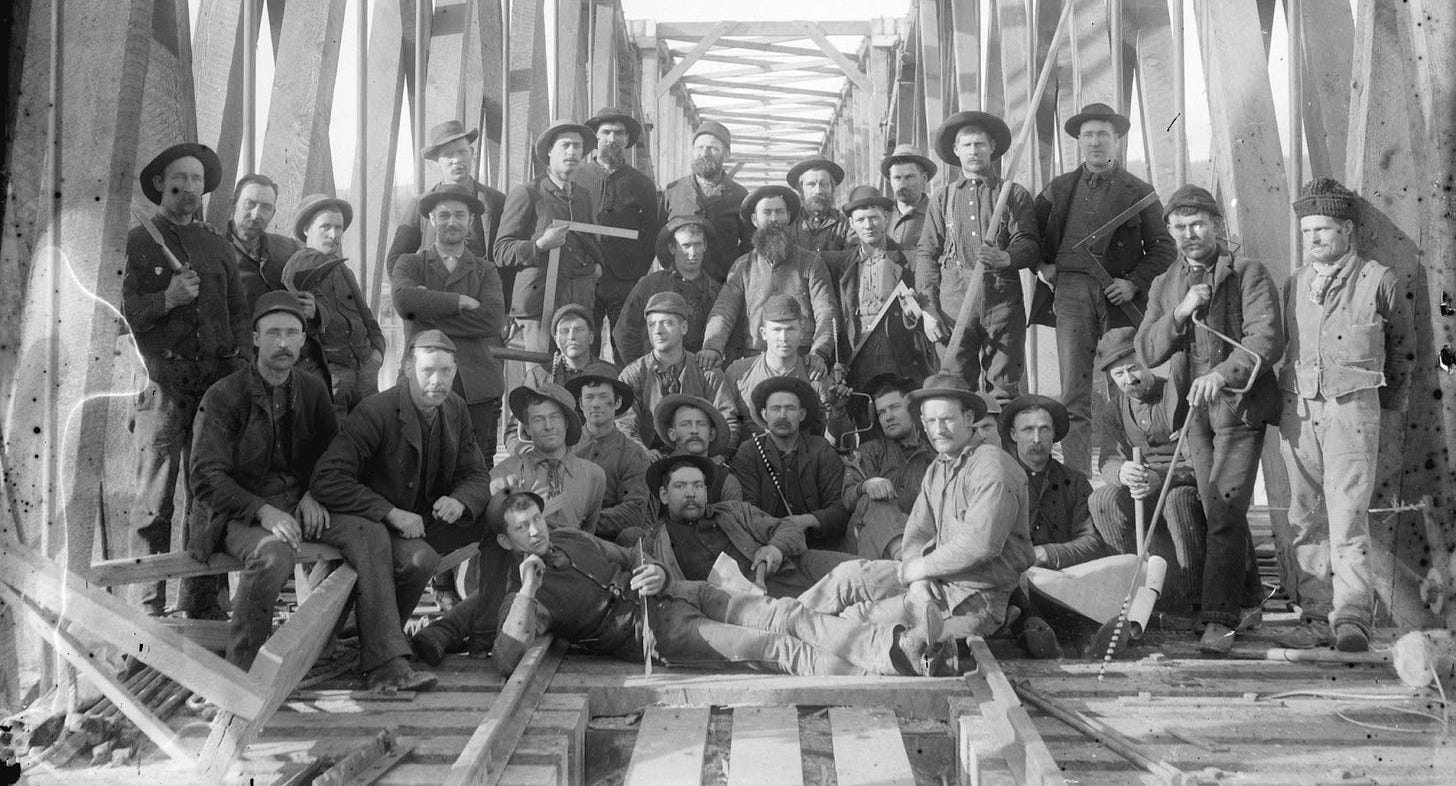
At least in the example of Israel Powell and the Vancouver Improvement Company, it was a small handful of rich and well-connected men who came out ahead. It’s hard to say who else benefited. Certainly not the schmucks who sunk their money into Port Moody. And definitely not the workers who built the railway for a meagre $1.50 to $2.50 a day (or $1 a day for Chinese workers). Depending on the source, anywhere from 600 to 2,200 workers died during construction, and many are still buried in unmarked graves along its tracks. The Sḵwx̱wú7mesh who were forcibly displaced from their territory without a treaty or compensation arguably fared the worst of all.
But there’s another point I want to make, beyond all that.
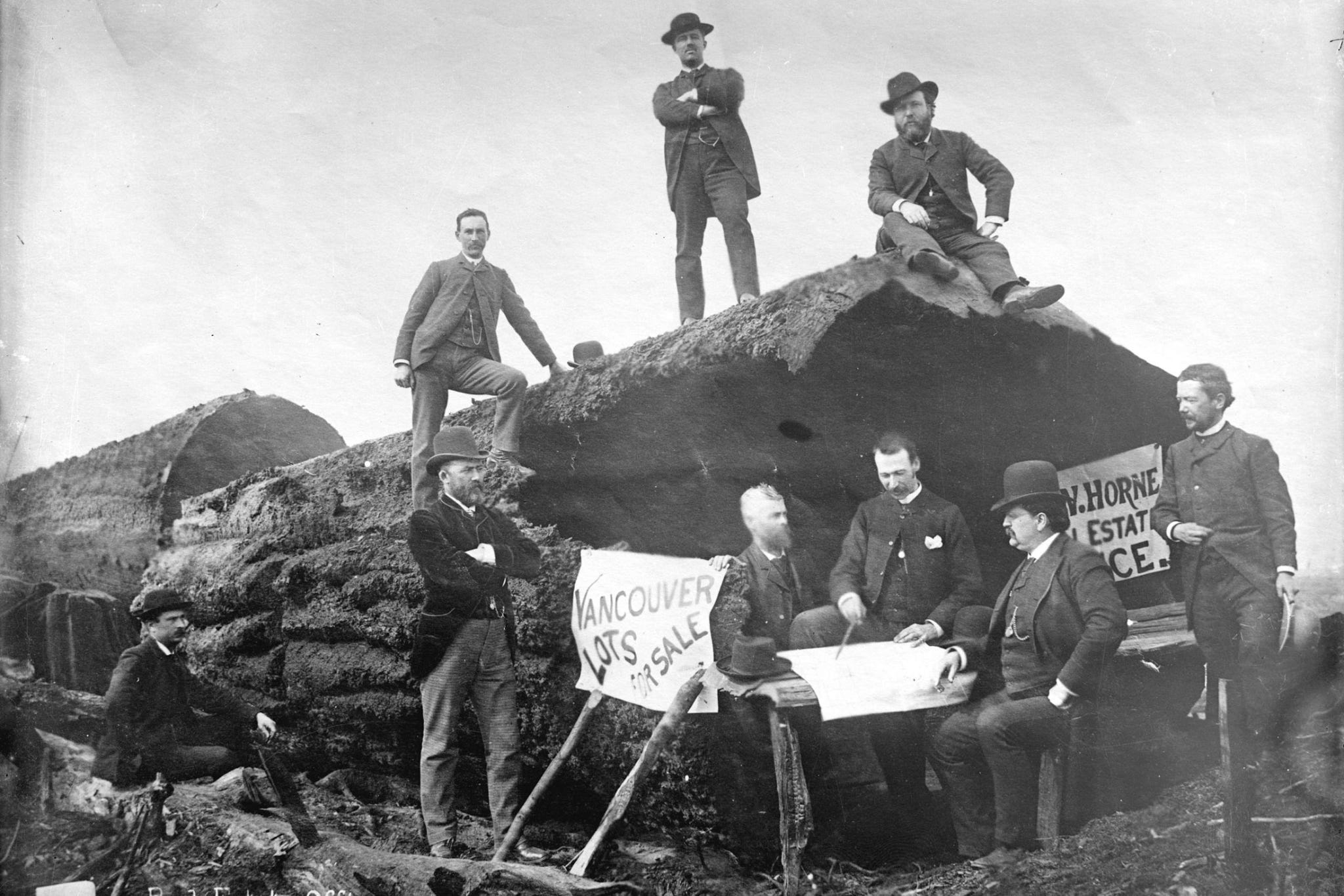
We tend to think of Vancouver’s housing crisis as a relatively modern phenomenon. But its roots run deep. Powell’s speculative land purchases laid the foundation for a city with unaffordability baked into its core. By 1910, Vancouver – only a few decades old – was swarming with more than six hundred real estate agents. Wealthy speculators and foreign capital dominated the market, leaving ordinary workers struggling to afford a home. As a newspaper columnist wrote of Vancouver in 1911:
“Land prices are high, it is said, higher than anything would warrant. ‘Why, the workingmen cannot afford to pay at the rate demanded for these tiny outside lots,’ asserted one man recently. The same thing was said here twenty years ago, answer the pioneers; others of us know that it was repeated ten years ago and five years ago, and our children and our children’s children will hear the same tale of woe decades hence.”
When politicians cut regulation and open up Indigenous land, it rarely benefits ordinary people like you and me. Inevitably, it’s well-connected rich guys like Chip Wilson, Jimmy Pattison, and other corporate landlord types who come out on top.
In other words, the Israel Powells of today.
Specifically, the BC Conservatives have promised to repeal Bill 43 (which set mandatory affordable housing targets for municipalities) and Bill 44 (which enacted long-term rental protections and increased density in single-family zoning across the province). It’s one of the few things the provincial NDP did that I was actually stoked on
It’s worth noting that Major Dupont had been fired a few years earlier from his job as Ontario’s Superintendent of Indian Affairs when an investigation found that he had stolen over 1,000 acres of Indigenous land at Manitowaning. The Wikwemikong First Nation and the Department of Indian Affairs’ Mismanagement of Petroleum Development
Excellent and fascinating work.
"They carved a wagon road up the Fraser Canyon to get to the gold."
As usual with "pop history," Doerksen gets the facts wrong. The "people who walked into the Cariboo with the clothes on their backs and a dream" were not the ones who built the Cariboo Road—either of them (the one from Lillooet being the older of the two).
The "Queen's Highway" from Yale via Cache Creek was built by a combination of the Royal Engineers and white contractors who hired Indigenous and Chinese labourers to do the actual work. Joseph Trutch—despite his famous racism and spite toward both Indigenous and Chinese people—hired them to build the Alexandra Bridge. It replaced an earlier Indigenous pole-and-vine bridge that had spanned the Fraser Canyon near that spot. Trutch hired San Francisco engineer Andrew Smith Hallidie to design it and financed the build himself in exchange for the right to collect bridge tolls for seven years. Because Trutch took over as Chief Commissioner of Lands and Works right after building the bridge, he ended up regulating and overseeing the very toll bridge he privately owned, creating a notable conflict of interest in early colonial politics.
In the case of the other route to the Cariboo, the Lakes Route (a.k.a. the Harrison–Lillooet Trail), parts of it were cut as a rough pack trail in 1858 by work parties of miners who each plunked down $25 as a deposit for the privilege of building designated sections—though many abandoned the work early to rush ahead to Cayoosh (Lillooet) and the Cariboo to stake their claims before anyone else got there. The Royal Engineers ultimately had to rebuild almost all of it into a proper wagon road.
The original Cariboo Road from Cayoosh/Lillooet to Soda Creek and Fort Alexandria actually began at Mile 0 in Parsonville, on the opposite side of the Fraser from where the town of Lillooet was surveyed in 1860 (when it was renamed because Americans disliked the sound of "Cayoosh" due to the recent Cayuse War in the U.S.). That road was built by American contractor Gustavus Blin Wright, of Britisih-Swedish origin, who employed mostly Germans and Scandinavians for his work parties.
Most Cariboo-bound miners could not afford the steep tolls on either route and did what they could to bypass the tollbooths. Most foot traffic from Lillooet to the Cariboo took the "River Trail," which followed the riverbank to Big Bar and then took easier trails across the plateau to the Cariboo—which at first didn't mean Barkerville, but the upper Cariboo River, where Quesnelle Forks was the main centre until Billy Barker struck it rich on Williams Creek in the upper Willow River watershed.
Doerksen misses the point when he says, "plenty of them went broke. Plenty of those camps are ghost towns today, but they went anyway for a chance to build something amazing." That statement says it all about resource-extraction economies: royalties and taxes are consumed by infrastructure spending, most of the wealth is exported to outside bank accounts, and almost none is reinvested in the communities founded in the process, which are left to rot once the resource is depleted or abandoned when world prices shift.
Total recorded gold production from the Cariboo goldfields since the 1860s exceeds 3.87 million ounces. Based on historical and current market prices, the estimated value of this production is roughly $3.4 billion to over $4.9 billion USD, yet almost none of it was reinvested in the towns or communities founded by its extraction—less than 5% to 10% remained directly in the mining towns as permanent local wealth. During the 1860s rush, the Crown did not charge a percentage royalty on gold extracted. Revenue came almost entirely from flat-rate Free Miner's Certificates (licenses), customs duties on imported goods, and road tolls. Because miners routinely smuggled gold across the U.S. border to avoid fees, public coffers captured only a fraction of the $50 million in 19th-century placer gold. Local retention was largely limited to worker wages, basic municipal taxes, and company-built housing; one of the few lasting local reinvestments was cattle ranching, which still anchors the regional economy today. Meanwhile, the road construction debt nearly bankrupted the mainland colony. By 1866, the colony was over $1 million in debt (a massive sum at the time), forcing its union with Vancouver Island and eventually pushing B.C. into Canadian Confederation in 1871 to have Ottawa assume its debts.