


This is one of the first essays I shared on the internet. I posted it on Medium back in 2022, but I only had 5 subscribers (shout-out to my Aunt Margaret), so not many people read it. It’s still one of my favourite essays, and writing it helped me clarify my thoughts on how history, activism, and local politics intersect. It’s a high I’ve been chasing ever since
Beacon Hill Park is a sprawling 183-acre park, a short walk from Victoria’s downtown core. With views across the Strait of Juan de Fuca to the Olympic mountains, a rare Garry oak ecosystem, and meandering paths through camas meadows, it is considered the crowning jewel of the city’s park system. Since March 2020, it has also been the site of a protracted struggle between the city’s housed and unhoused communities, a fight that recently reached the Supreme Court of BC.
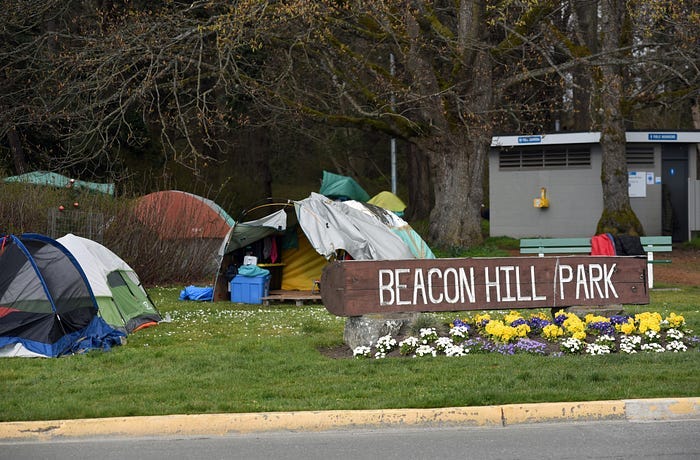
At the start of the pandemic, shelters and social services shut down, leaving an estimated 465 people to fend for themselves. In response, the City of Victoria temporarily suspended its bylaw prohibiting overnight camping. Then, through a series of police enforcements, the city pushed people from the highly visible downtown core into Beacon Hill Park.
In a never-ending game of not-in-my-backyard, the non-profit society Friends of Beacon Hill Park filed a lawsuit against the city, arguing that overnight sheltering is a violation of the 1882 Trust that governs the park.
One of the city’s co-defendants, Together Against Poverty Society, reminded the court that access to shelter is guaranteed by the Canadian Charter of Rights and Freedoms, and that bans against overnight sheltering are illegal.1
But, the judge chose to ignore the question of Charter rights, saying that the “proceeding is not a challenge to the Trust’s legality, on constitutional or any other grounds.” Instead, the debate was confined to an interpretation of the Trust, and the judge agreed with the Friends of Beacon Hill Park that it “does not permit use of the Park for temporary sheltering by persons experiencing homelessness.”
His decision hinged on one particular line — that the park must be maintained and preserved “for the use recreation and enjoyment of the public.”
Essentially, the debate was: does emergency sheltering count as one of the public uses intended by the original authors of the Trust? In framing the debate this way, the court ignored a much more interesting and telling question: Who is the public, and whose use, recreation, and enjoyment are we maintaining and preserving?
With that question in mind, I want to explore the history of Beacon Hill and place the court’s decision within a larger historical context. Because I think the story of Beacon Hill reveals a much larger story, a story about Victoria, and about Canada as a whole.
MEEGAN
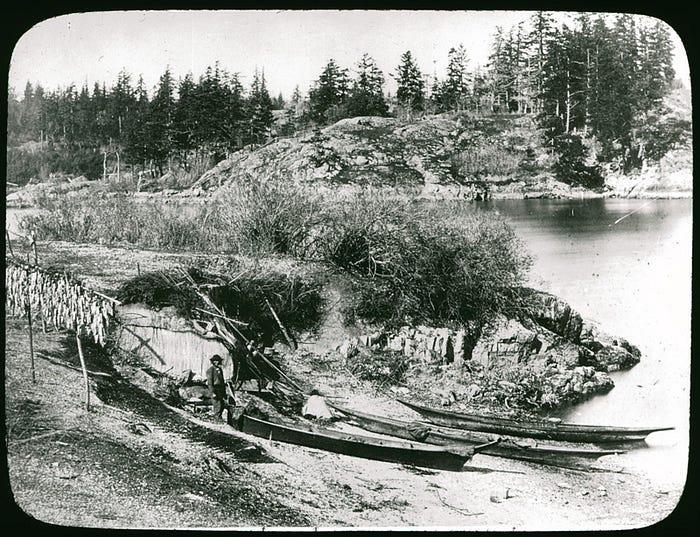
Before Europeans arrived, Beacon Hill Park was known by a different name — MEEGAN, a Lekwungen word roughly translated as “a place to warm your belly”. The result of careful land management over countless generations, the landscape was a productive food garden and one of the continent’s most densely populated areas. To this day, the meadows are filled with the purple flowers of kwetlal (camas) - the starchy root was, and continues to be, cultivated and valued as a food source unique to the region’s rare Gary oak ecosystem. Before extensive dredging and blasting that started in 1873, the inner harbour was a large mudflat and one of the most productive clam gardens on the coast. To the north, the Gorge Waterway was host to abundant seasonal runs of herring and Coho salmon.
Lekwungen laws and protocol worked to maintain a lush, cultivated landscape abundant with food, as an early colonist, James Bell observed:
“we are indebted to the Indians for a supply of everything in season …at very reasonable rates; They collect great quantities of Berries,…For a back load of Potatoes they charge one shilling; these they cultivate by simply burying the seed under the green turf; A fine salmon can also be purchased for one shilling; …Cod, Herrings, Flounders &c are always to be had cheap; A large Basket of Oysters one shilling; The market is also supplied with plenty of venison, Deer are quite plentiful, until the arrival of the American Hunters”
MEEGAN began to change dramatically when the entire Victoria area was “bought” in 1850 by James Douglas, the first Governor of the Colony of British Columbia. No money was ever exchanged in the purchase, as Douglas explains, “They were paid in goods, mostly blankets, from the Fort Victoria stores and the value to the Indians included a markup of approximately 300 per cent.”
With different cultural understandings of property and ownership, and negotiating terms through a language barrier, the Lekwengun people interpreted the treaty as a peace offering and an agreement to share the land. In 1934, Songhees Chief Davit Latass was clear that “never, never did the Indians sign away title to their land for just a few blankets.” In 2000, Songhees Chief Robert Sam reiterated that,
“This land, we did not forfeit to anyone. A treaty was signed for 147 Hudson’s Bay blankets for borrowing this land. The blankets that were shared with the Lekwammen Nation have long since disintegrated. We have never sold our land.”
Still, shortly after signing the treaty, MEEGAN was cleared, and the Lekwungen people were forced across the harbour to the newly established Songhees Reserve.
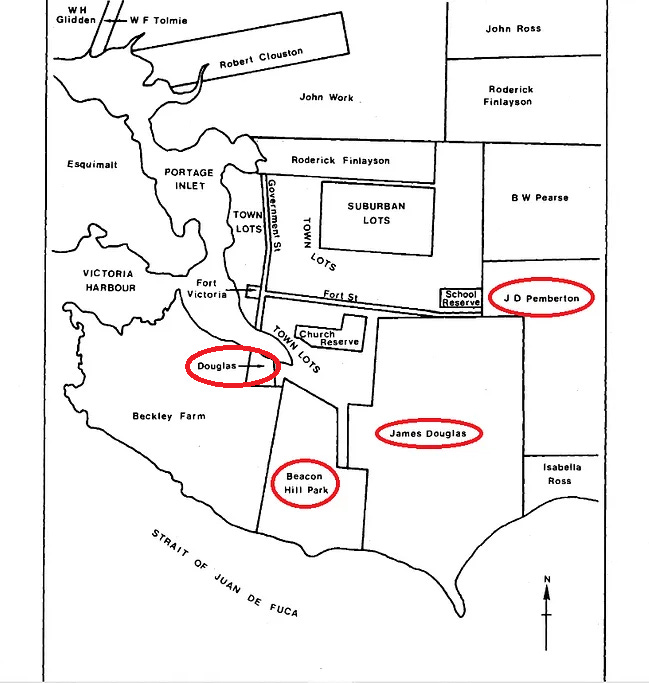
With little oversight from a distant colonial administration in Britain, Douglas was able to divvy up and sell the newly acquired Lekwungen lands as he saw fit. In 1850, Douglas had the property lines for Beacon Hill Park surveyed. The same year, he bought 300 acres of productive agricultural land along the park’s eastern boundary, which, in 1852, was expanded to 418 acres and another 24-acre parcel on the northwest corner of the park. Douglas wasn’t secretive about his intentions, as he wrote in a letter to a friend: “I am thinking of making a purchase of land on Vancouver’s Island…more as a speculation than with any serious intentions of settling.” The colony’s surveyor, Joseph Pemberton, confirms in a letter that “it was Sir James Douglas who made us rich by insisting upon our taking up land.”
It’s hard to escape the idea that, from its earliest inception, a primary function of Beacon Hill Park was to inflate nearby land values and make a few men rich.
To fast-forward to the present, what followed was years of gradual transformation of MEEGAN into a European-style park. Burial cairns were dug up, the Indigenous bones underneath collected and displayed as curiosities in fashionable Victorian homes. Familiar plants from England, like “cowslips and primroses and hawthorn hedges and all the Englishy flowers”, were planted and crowded out the native flora. As the city grew, the Songhees Reserve land became more valuable. The British Colonist published opinions, wondering:
“how much longer are we to be inflicted with the intolerable nuisance of having hundreds upon hundreds of hideous half-naked, drunken savages in our midst?”
In 1911, the reserve was moved even farther from the downtown core, to where it stands now in Esquimalt. On the forced relocation of the Lekwungen people, Douglas wrote that “the Town of Victoria will not be retarded by their unprofitable occupation of one of the most valuable portions”. Treaty rights stating that the Lekwungen could continue hunting, fishing, and food gathering forever were effectively denied, and traditional land management was criminalised. The criminalisation continues to this day — Songhees traditional knowledge holder, Cheryl Bryce, has shared how police have been repeatedly called on her for harvesting kwetlal at MEEGAN.
With the Indigenous presence effectively erased, or at least controlled, the enforcement of who is allowed to use the park shifted to a new class of interloper - “squatters and paupers.” Or, in modern terms, the unhoused.
the war on homeless people
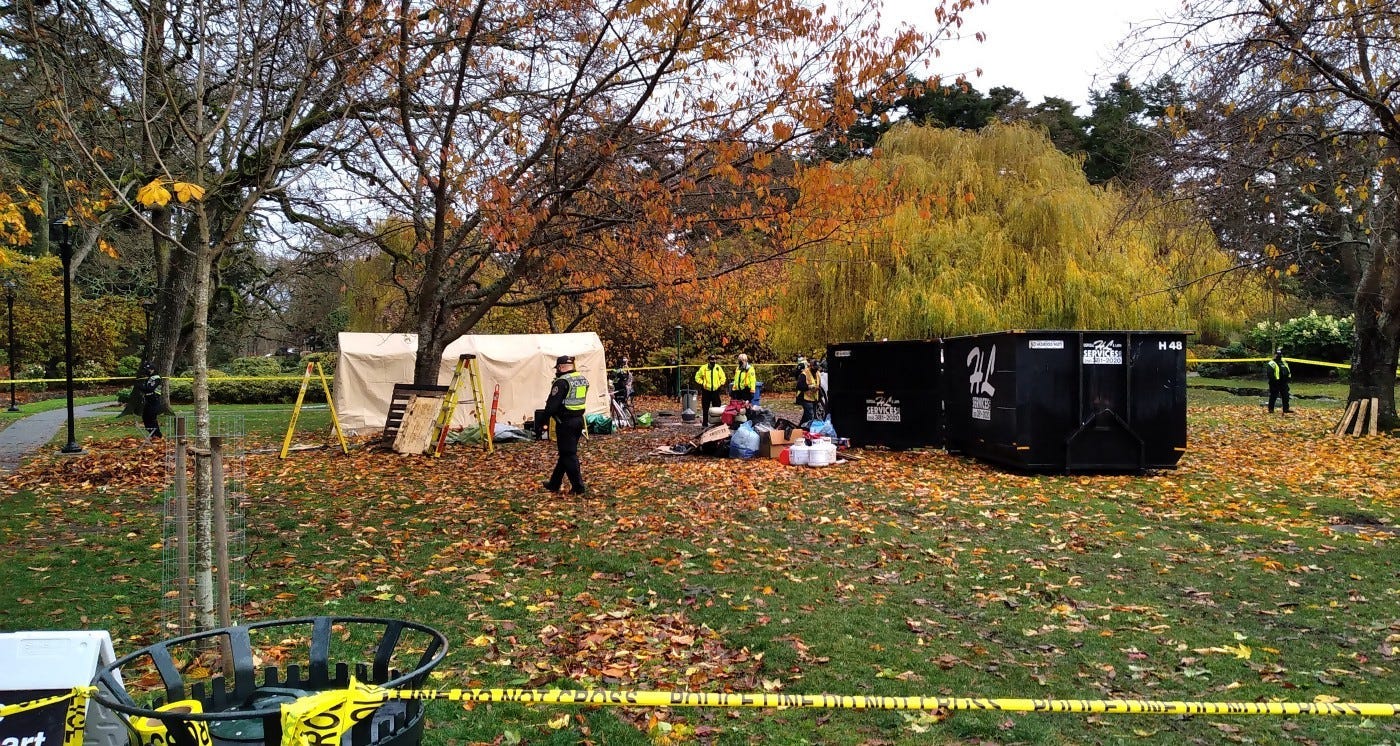
My involvement with and interest in MEEGAN started around March 2020. Hundreds of people had been kicked out of shelters, pushed from the streets, and forced to shelter in the park. It quickly became clear that the city had no plan for how it was going to provide them with even basic services.
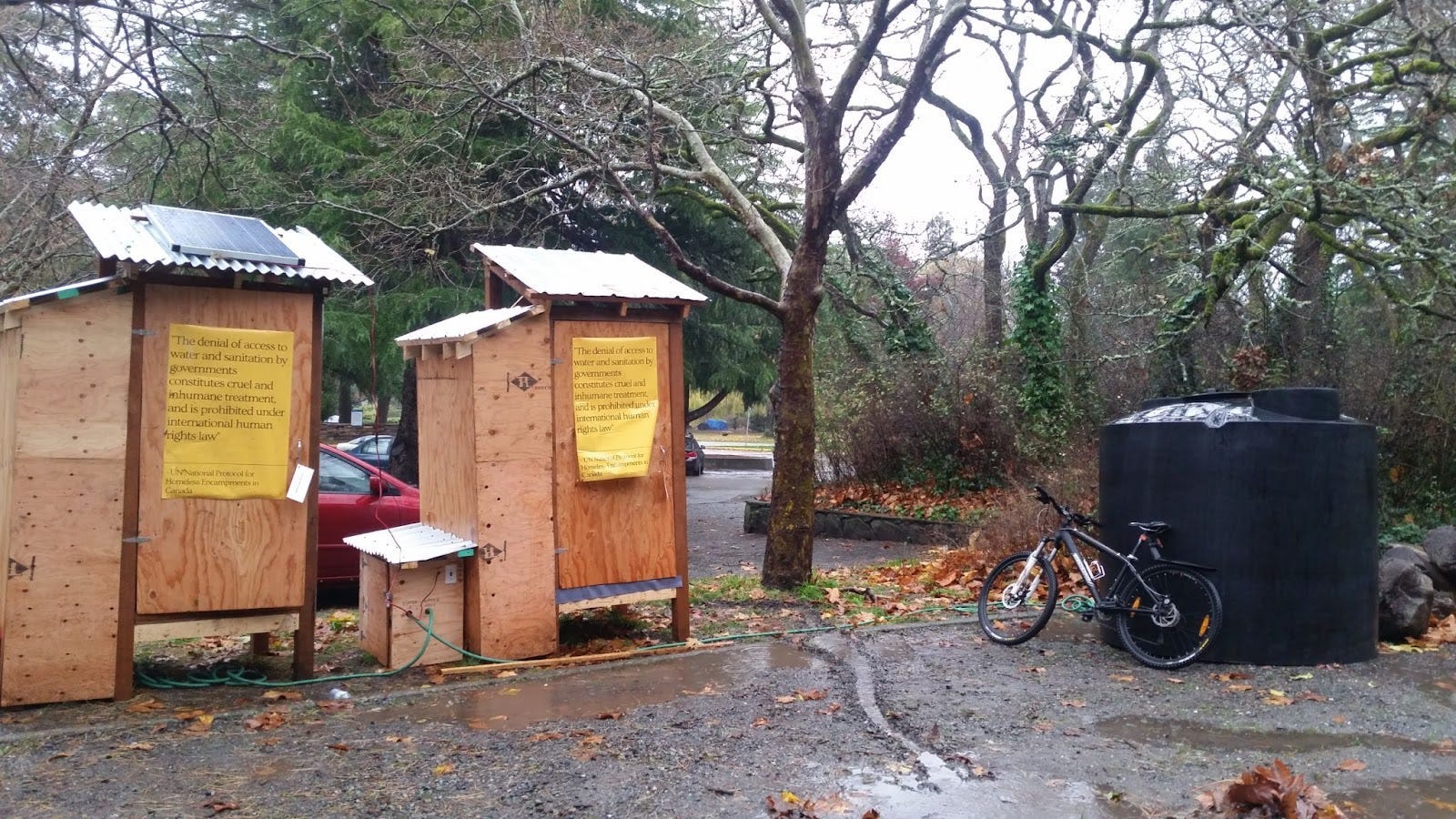
Into this vacuum stepped some of the most impressive and inspiring examples of mutual aid I’ve witnessed. Homeless campers looked after each other and organised weekly meetings. A care tent was established and run by volunteers to stock donations of sleeping bags, tents, first-aid kits, naloxone, and other survival supplies. A warming tent gave space for people to warm up and dry their clothes. With no hygiene facilities available, the community fundraised over $10,000 to build DIY portable shower stalls.
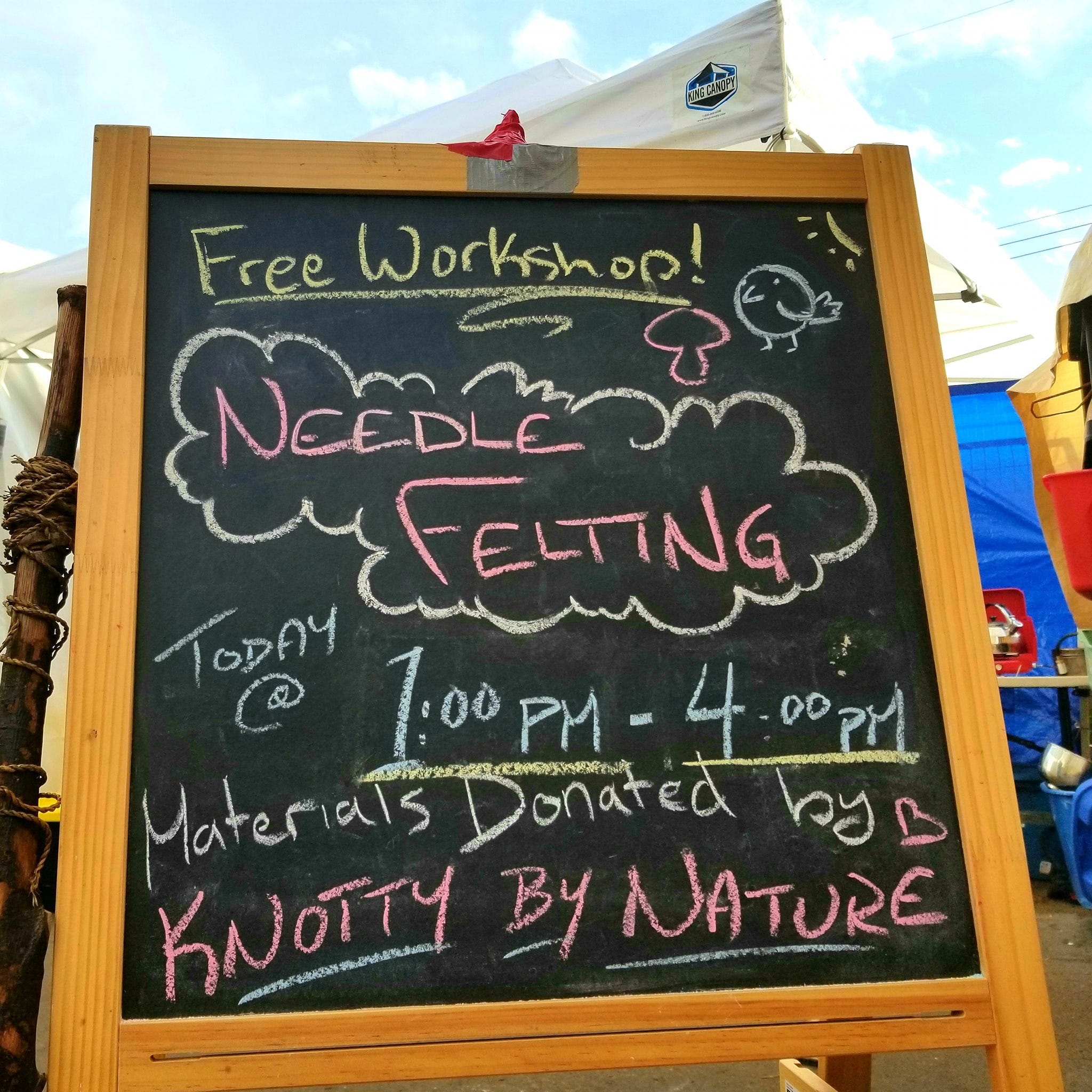
But the city wasn’t stoked. Instead of celebrating the community’s achievements, they gave notice that we were in violation of its bylaws.
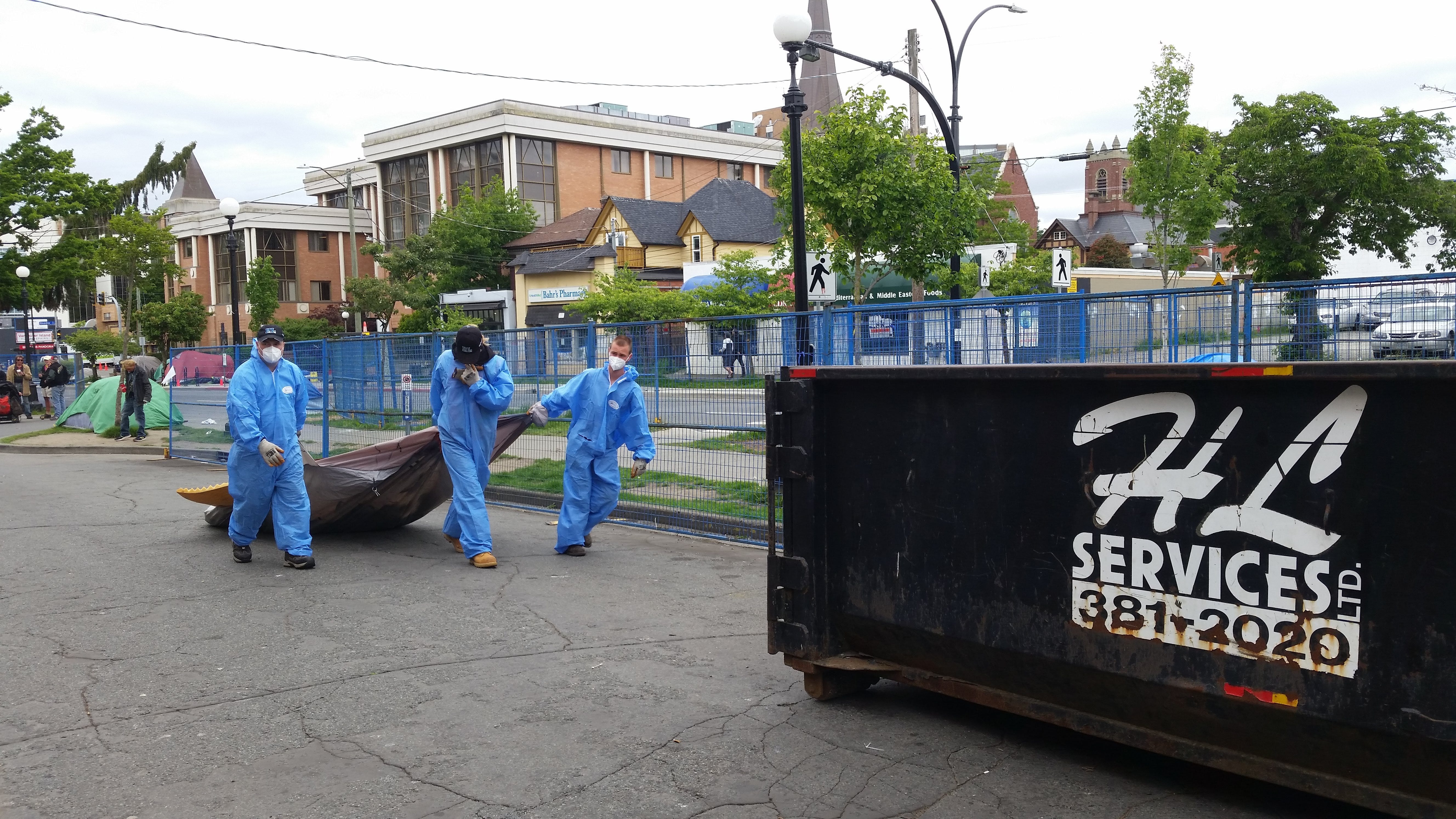
By late fall, a team of roughly thirty police and bylaw officers showed up to impound the community care tent and shower stalls. Eventually, the care tent was given a temporary permit to operate nearby, outside of the park — but the community was left without a warming tent for weeks in the middle of winter, and countless donations and personal belongings were sent to the landfill by city staff. Despite our insistence that “the denial of access to water and sanitation by governments constitutes cruel and inhumane treatment, and is prohibited under international human rights law,” the city provided no alternative access to showers or hygiene facilities.
Which brings us back to the question,
who is the public?
The history of MEEGAN makes clear who isn’t considered the public - Indigenous people and the unhoused. But I’d like to take it one step further and suggest that I, and likely you, are also not members of the public whose rights the courts will defend.
The public is, and always has been, landowners and the wealthy.
Yet, over sixty per cent of us in Victoria are renters. With stagnant wages, high inflation, low vacancy, and runaway housing prices, the majority of us have more in common with the homeless campers at MEEGAN than with homeowners fighting tooth and nail for their property values.
It’s an interpretation affirmed in Victoria (City) v. Adams (2008), in which the judge ruled that the city’s prohibition against overnight sheltering is a violation of homeless campers’ Charter rights:
“I have found further that the effect of the prohibition is to impose upon those homeless persons, who are among the most vulnerable and marginalized of the City’s residents, significant and potentially severe additional health risks. In addition, sleep and shelter are necessary preconditions to any kind of security, liberty or human flourishing. I have concluded that the prohibition on taking a temporary abode contained in the Bylaws and operational policy constitutes an interference with the life, liberty and security of the person of these homeless people. I have concluded that the prohibition is both arbitrary and overbroad and hence not consistent with the principles of fundamental justice. I finally have concluded further that infringement is not justified pursuant to s. 1 of the Charter.”