


“It is not our part to master all the tides of the world, but to do what is in us for the succour of those years wherein we are set, uprooting the evil in the fields that we know, so that those who live after may have clean earth to till”
- Gandalf the White, quoted by Pope Leo XIV in his Encyclical Magnifica Humanitas, Safeguarding the Person in the Time of Artificial Intelligence

By now, you’ve probably heard about Telus’ data centre planned for downtown Vancouver. It’s a 400,000 square foot, 10-storey, 100-megawatt behemoth that, once it’s up and running, will produce the thermal energy equivalent of burning 28,000 lbs of coal every single hour.1
With its central location, it’s been getting a lot of attention.
But it’s just a small part of Canada’s entry into the AI arms race, part of Ottawa’s Enabling Large-Scale Sovereign AI Data Centres initiative. In BC alone, Telus is building two more - another in Vancouver and one in Kamloops. Bell is building six, part of their 500-megawatt sovereign AI Fabric supercluster.
It’s hard to overstate how much power they’re going to need. To give a reference, BC Hydro’s generating capacity for all of Vancouver Island is only 471 megawatts.

As a result, the province is on track to max out its existing power supply within the next few years. So, the plan is to build a series of mega dams across the province, including Site E on the Peace River and on the Homathko River in Bute Inlet.
But hydropower alone won’t meet the projected shortfall. BC Hydro is walking back from its obligation under the Clean Energy Act to transition off fossil fuels by 2030. Instead, it’s seeking to extend contracts with two major gas plants which will collectively consume ten billion cubic feet of methane every year.

People aren’t stoked. According to a recent poll, two-thirds of British Columbians want the government to heavily regulate AI, even if it slows development; only three per cent think it’ll create more jobs; and seventy per cent oppose data centres being built near their home.
So, why are they getting shoved down our throats?
the case for Canadian data centres
It’s no secret that, ever since the dot-com boom of the 90s, the internet has increasingly been dominated by a handful of American corporations.
The Global Media and Internet Concentration Project has been tracking the consolidation of power for over a decade. According to their most recent report, ninety per cent of Canada’s online advertising market is controlled by just three companies - Amazon, Google, and Meta. Similarly, less than fifteen per cent of Canada’s streaming market is Canadian-owned. Canada’s cloud computing market, already worth $18 billion and growing, is just the latest battleground for American corporate domination.
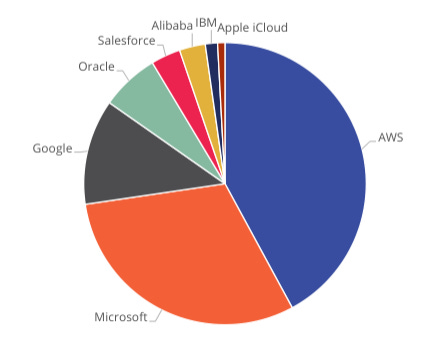
When just a few companies control a market, it’s called an oligopoly. The lack of competition tends to be good for shareholders, but bad for consumers.
I’m sure you’ve noticed. Cory Doctorow, author and tech journalist, calls it enshittification. Social media, once a way to keep in touch with friends, has morphed into a swamp of brainrot. Now that we’re hooked on Uber and Airbnb, they’ve jacked up their fees. Unskippable ads, algorithmic polarisation, generic AI-generated content…
The internet’s getting greedier, but there’s something even more concerning going on.

American laws like the Foreign Intelligence Surveillance Act (FISA) and Clarifying Lawful Overseas Use of Data Act (CLOUD) give the American government the power to access data anywhere in the world, as long as an American company owns the data centre it’s stored on. Canadian laws that regulate data security, like BC’s Freedom of Information and Protection of Privacy Act (FIPPA), are effectively useless.
It’s not just our photos and search history getting slurped up. We’re talking national security. In the federal government’s own words,
“Canada cannot ensure full sovereignty over its data when it stores data in the cloud… Sensitive GC [Government of Canada] data could be subject to foreign laws and be disclosed to another government. Under some foreign laws, disclosure of GC data could take place without notice to the GC.”
Which wouldn’t be such a big deal if the government hadn’t already transitioned to the cloud. Over the past five years, Ottawa spent over $1.3 billion on American-owned cloud services. The Department of National Defence is the biggest spender, using Microsoft and Amazon Web Services to host “several mission-critical applications that directly support operational readiness and national security.”
the devil we know
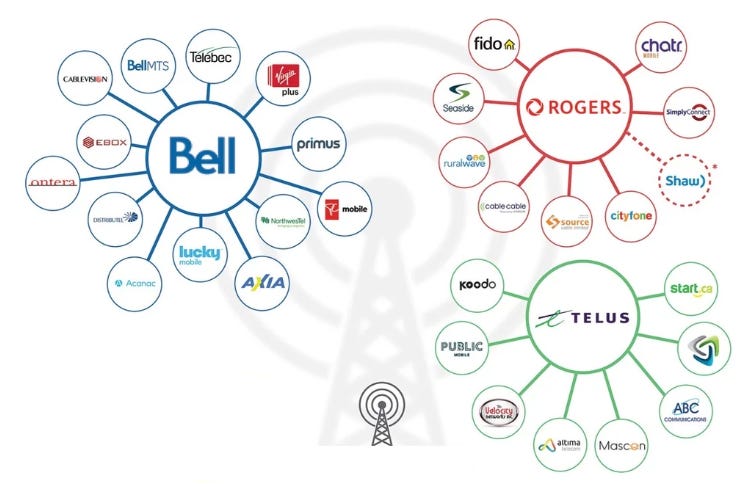
So, Canada is handing the reins over to two of its biggest companies, Telus and Bell.
The idea is, Canadian-owned data centres will help protect our data from overreach by the American state. Which makes sense. But, if we’re concerned about corporate oligopoly and the unchecked power of a few impossibly rich men, it’s a weird choice.
After all, Telus’ president, Darren Entwistle, is one of the richest men in Canada.2 In 2024 alone, he made over $20 million. He’s an outspoken critic of restrictions on foreign investment and has threatened mass layoffs in retaliation for government regulation. It’s hard to imagine him as our saviour.

Still, one could argue Entwistle earned his fortune. Since becoming president in 2000, he’s generated a 661 per cent return for shareholders, quintupling Telus’ value to $53.8 billion and growing it into the sixteenth most valuable telco in the world.
But Entwistle’s success has come at the direct expense of his workers. In January, he issued nearly 700 voluntary severance packages, mainly to employees in BC and Alberta. He cut 2,800 Canadian jobs in 2025, 3,300 in 2024, and 4,000 in 2023. Altogether, he’s slashed Telus’ Canadian workforce by thirty-two per cent over the past decade.
Despite the cuts, Telus’ services are among the most expensive in the world, and its customer service is so bad the government is considering an intervention. You could say it’s been enshitified. In the words of the United Steelworkers Local 1944 (which represents some 4,000 Telus employees), “workforce reductions at Telus hurt communities and the Canadian economy, and only exacerbate Canadians’ growing dissatisfaction with the service they’re receiving from telecommunications companies.”
The only reason Entwistle can be seen as a success is that he’s accountable to his shareholders - not his workers or the public that uses his services. Seen from another angle, he hasn’t really been growing Telus at all. Rather, he’s been draining a public asset, siphoning wealth away from the commons and lining his own pockets.
Because, not that long ago,
Telus was a publicly-owned utility

Before it was privatised in 1991, Telus was known as Alberta Government Telephones (AGT) and operated under a mandate to provide affordable phone service to all Albertans. Profits funded public services like healthcare and education, rather than being paid out as dividends to private investors and executives.
AGT didn’t come from nowhere. It was born out of resistance to an American-backed monopoly. One that, for decades, held an iron grip over Canada’s telephone industry.
The story starts in 1880, when Parliament gave Bell exclusive rights to build phone lines along all public rights-of-way across the country. As a subsidiary of the Bell Telephone Company, headquartered in Boston, Bell’s Canadian expansion was financed by powerful American interests. By 1904, Bell controlled nearly three-quarters of the Canadian market and its profit margins were an impressive fifteen to thirty per cent.
But service was limited to a wealthy urban elite and less than two per cent of Canadians had phone service. It wasn’t profitable enough for Bell to bother extending its service to small towns. As a Bell executive bluntly put it during a 1905 parliamentary inquiry into the company’s monopoly,
“If it is a question of erecting an exchange in one large place and of giving a service needed by 1,000 people, we certainly, and quite properly, in doing that give preference to the needs of a large number rather than to a lot of farmers’ lines.”
It was more than neglect. Bell actively cock-blocked the development of Canada’s rural phone infrastructure. It wrote clauses into its contracts with railway companies, requiring them to deny access to its competitors; It restricted access to its critical urban phone exchanges; On the rare occasions when Bell allowed access, it was on the condition that its competition limit their expansion and buy equipment exclusively from Bell’s own manufacturer.
Ottawa’s inquiry, led by Sir William Mulock, is jam-packed with testimony to Bell’s aggressive use of litigation, bribery, and outright harassment. Mulock wasn’t shy about his goal of breaking up Bell’s monopoly and nationalising the phone service.
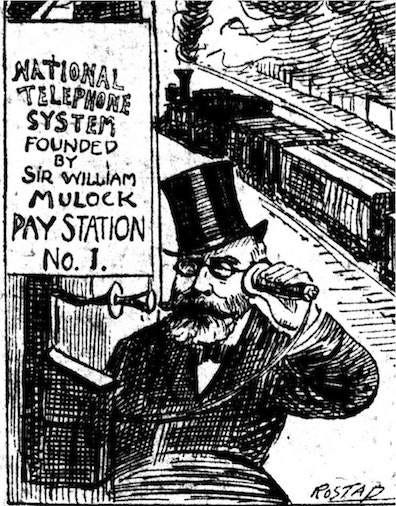
When the New York Times asked Mulock if government ownership wasn’t a step toward socialism, he answered:
“Well, what is the matter with Socialism, if it is on a good foundation? Some of the advantages of a Government ownership of the telegraph lines is in the first place that it insures secrecy, and unless there is such ownership there is no pledge that messages given to companies will be secret; again, under a Government ownership there is always a cheaper service, which is an advantage to the people.”
Before the inquiry finished, Mulock was sent away to a conference in England. The inquiry limply concluded while he was abroad, void of any policy recommendations. A few months later, Mulock was removed from his position as Postmaster General and replaced by one of Bell’s lawyers.
Bell won the battle against federal expropriation, but the war waged on.
In 1907, hundreds of Bell’s switchboard operators in Toronto went on strike against wage cuts and schedule changes. In solidarity, the influential editor of the Toronto World started a public strike fund. The Canadian Public Ownership League launched a campaign to advocate for municipal and provincial ownership of Bell’s infrastructure.
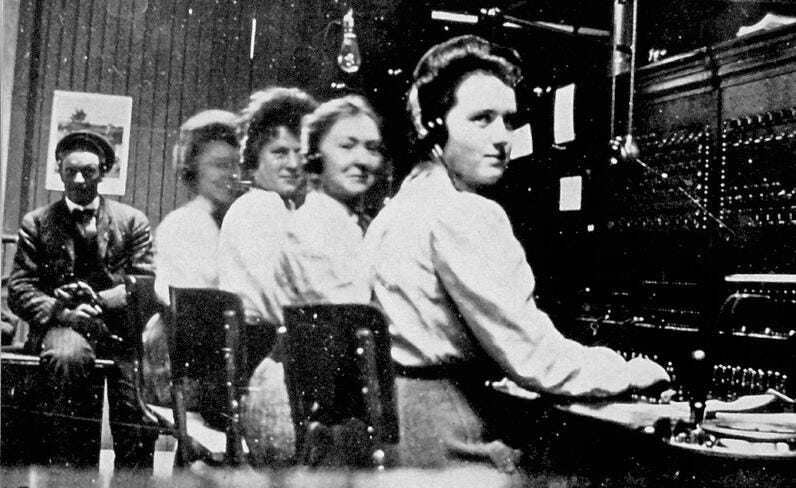
Bell crushed the strike, but sympathy for the switchboard operators (who were mostly young white women) was high and a wave of support for public ownership swept across the country.
In 1908, Alberta took over Bell’s operations, forming Alberta Government Telephones. The same year, the Manitoba Telephone System and Saskatchewan Telephone Company formed, kicking Bell out of the prairies. Dozens of cities across the country formed their own municipal telcos.
By any measure, the public telcos were a success. They expanded phone service into rural areas, kept fees low, and steadily grew throughout the twentieth century. By 1960, despite its huge distances and low population density, Canada had more phones per capita than any other country. By the early 80s, public telcos controlled a quarter of the market.
But the good times didn’t last. The election of Brian Mulroney’s Progressive Conservatives in 1984 marked a turning point for public ownership as a wave of privatisation swept the country. Under Mulroney, the government raised $8.8 billion selling off public telcos. Caught up in the frenzy, AGT was sold by Alberta in 1991; AGT bought EdTel from the City of Edmonton in 1995; and AGT merged with BCTel in 1999 to become the Telus Corporation.
Today, the cash from privatisation is long gone, and only two per cent of the market still belongs to public telcos. But the ones that survived continue to generate impressive returns for their communities.
In June, SaskTel paid $41.9 million in dividends to the Saskatchewan government. CityWest in Prince Rupert is the last municipally owned telco west of Ontario. Since 2005, it’s paid over $10 million in dividends to the city. Tbaytel, the largest municipal telco in Canada, provides free public wifi throughout Thunder Bay. Last year, it paid the city a whopping $23 million dividend - funding public services and reducing property taxes by eight per cent.
Meanwhile, Telus’ profits are crammed into the pockets of its billionaire executives and private shareholders. Little, if any, trickles down to the rest of us.
we don’t have to capitalism everything
“I think that I now understand what he is up to. He is plotting to become a Power. He has a mind of metal and wheels; and he does not care for growing things, except as far as they serve him for the moment.”
- Treebeard (Master of Fangorn’s Wood)

In response to some pretty serious existential threats – climate collapse and the rise of American techno-fascism – Canada is propping up a few of its own homegrown oligarchs and calling it a day.
It’s a depressingly limp strategy that wilfully ignores the tools previous generations used to break up American monopolies. There’s no talk of publicly-owned alternatives, let alone expropriating data centres from American corporations that defy Canadian law. Instead, the government continues to welcome American megacorporations with open arms. For example, earlier this month, Alberta announced that Meta will build a $13 billion, 1,000-megawatt data centre, powered by a new gas-fired power plant.
Having Telus and Bell build a handful of Canadian data centres is just tossing maple syrup into the mix of billionaires who are driving our planet off a cliff.
William Mulock, our wrongfully dismissed Postmaster General from 1905, had the right idea. Industries that depend on easily monopolised infrastructure (like telephone exchanges or data centres) shouldn’t be controlled by private capital. Rather, they should be public utilities that operate over the scale of generations, generating profit for the common good.
Almost all of the electrical power used by servers is exhausted as heat, meaning 1 MW of server power = 1 MW of thermal output. 100 MW = 341,214,245 BTU per hour. Burning 1lb of coal produces 12,000 BTU. Therefore, a 100 MW data centre produces the thermal energy equivalent of burning 28,434 lbs of coal per hour.
Annoyingly, Darren Entwistle retired on July 1, while I was writing this. The new CEO, Victor Dodig, is the former president of CIBC and a billionaire. Different guy, same problem
Great post. My one note would be that BC Hydro's demand projections aren't entirely being thrown off by data centres, which I suspect we could manage. Rather, it's the various extractive projects (LNG, mining) that is set to blow the lid off the projections. It's hard to get exact numbers, because industry and government don't like talking about it, but I believe even single projects like LNG Canada are set to consume more electricity than all data centres combined.