


“You don’t need to go to Tim Hortons at 70 kilometres an hour.”
- Alda Bishop, Powell River resident and Joyce Avenue hater
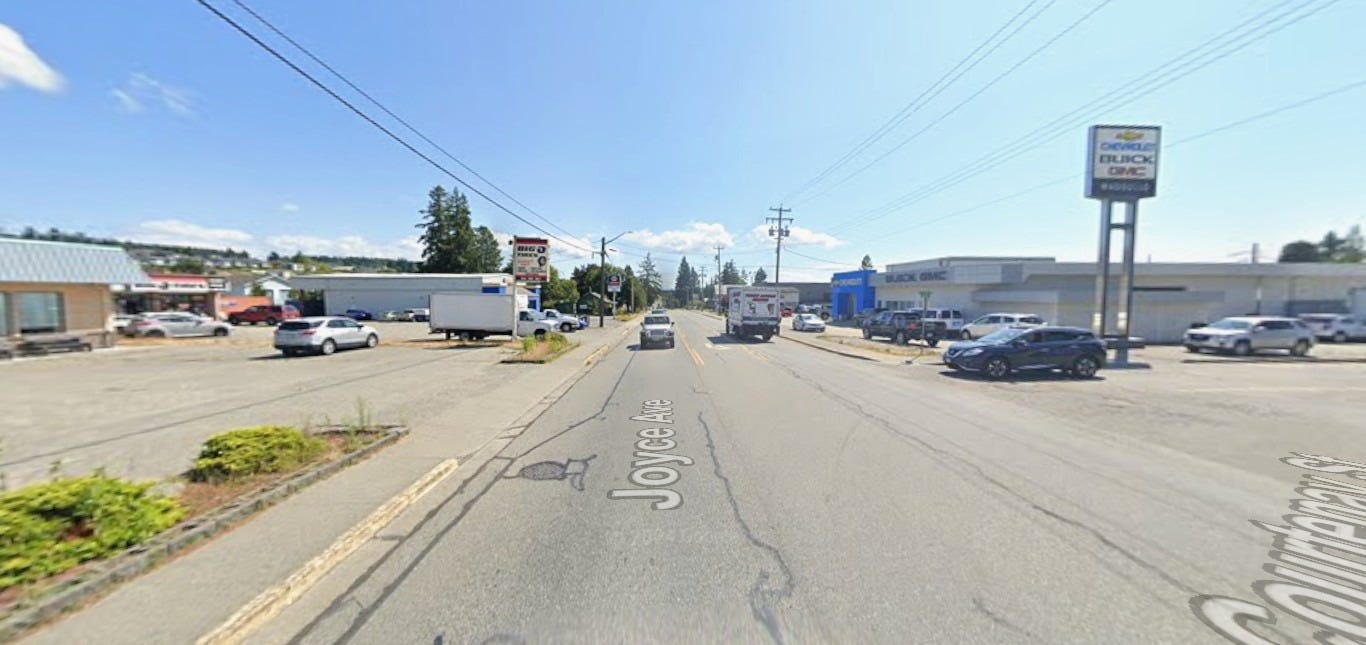
A few weeks ago, I dropped my van off at Big O Tires to get my tires changed. It was a nice day, and I was working on a renovation a few blocks away, so I decided to walk back to work. Before I’d made it more than a block or two down Joyce Ave, my phone rang. A friend was driving past, saw me walking, and wanted to make sure that I was okay.
Which, honestly, was touching. Walking on Joyce is concerning.
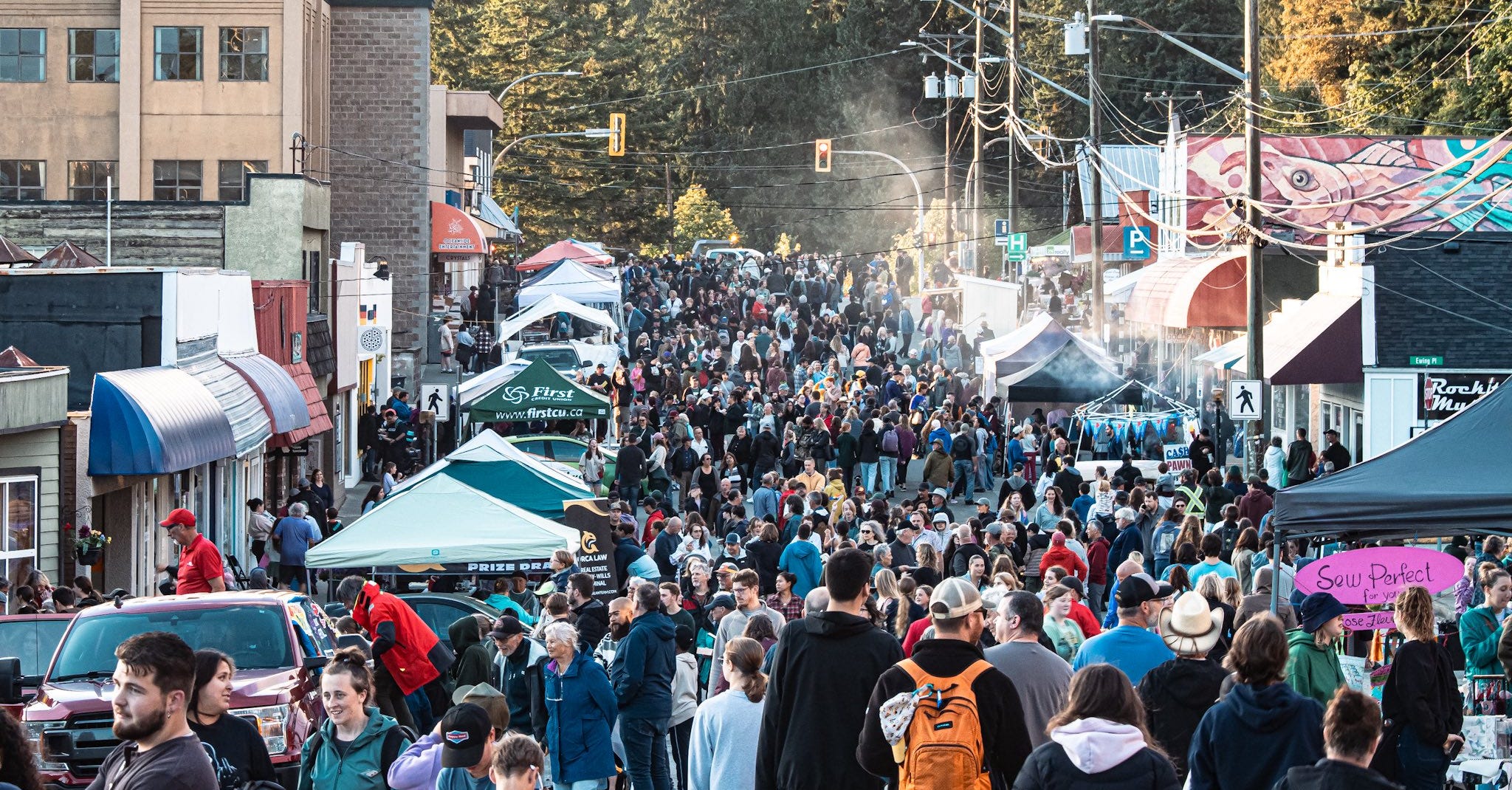
Despite being the commercial heart of the city, Powell River’s biggest street wasn’t built with the lowly pedestrian in mind. The sidewalk is just a few feet wide, and when someone squeezes past with a baby stroller or mobility scooter, you’ve got to step aside to make room.
In contrast, with three spacious lanes, the section of the avenue reserved for cars feels like a highway. Speeding is a problem. A small yellow curb is the only thing between you and trucks blasting by fast enough that if one crashes into you, you’re practically guaranteed to die.
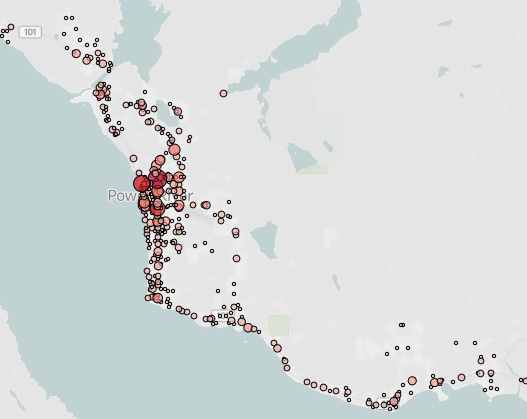
It’s no wonder most people choose to drive.
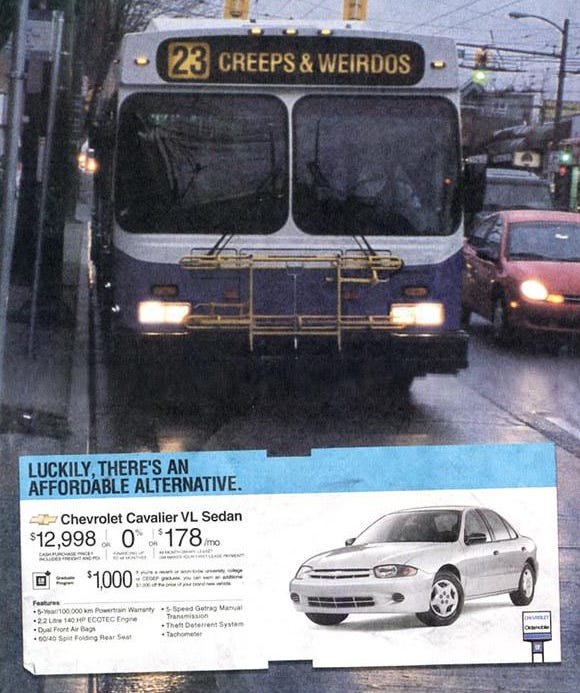
We’ve built our city so that it’s inconvenient, dangerous, and unpleasant to get around any other way. I live in Cranberry, an hour’s walk from the post office, library, and grocery stores that are on Joyce. There’s a bus that goes to Joyce, but it only comes once an hour. A few years ago, a bike lane was painted on the shoulder of Manson Ave - but it’s narrow, gravelly, and speeding cars treat it with questionable respect. Not many people use it.
The problem is, there’s lots of people who can’t drive - like kids, seniors, or people with disabilities. Others can’t afford to drive. When you consider all the expenses like gas, insurance, and repairs, it costs the average Canadian $7,029 a year to own a vehicle. For someone making Powell River’s median wage, that’s two months of full-time work. By making cars the only safe and reliable way to get around, we’re telling non-drivers – a considerable portion of Powell Riverites – that the city isn’t for them.
it didn’t use to be this way
“Cars were few and far between, with many residents and millworkers using buses to get around. Four or five separate numbered routes, if you can believe it. It just shows you how high the volume was. You could pick up a bus every 15 or 20 minutes there.”
- Stewart Alsgard, former mayor of Powell River, describing what Cranberry was like in the 1950s
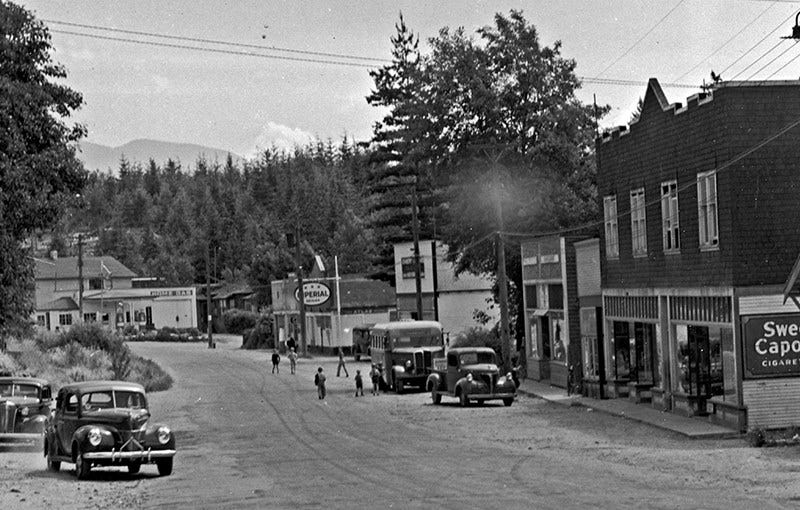
Before Joyce took over as the commercial heart of Powell River, the villages of Townsite, Cranberry, Wildwood, and Westview each had their own thriving downtowns.
In my neighbourhood, Cranberry, everything you needed was within easy walking distance. There were two bakeries, two trucking companies, two garages, a hardware store, furniture store, post office, jeweler, print shop, newspaper, butcher, and a general store. There was even an indoor roller rink, bowling alley, and dance hall. Cranberry lake still had cranberries. In the summer, you could swim in it without getting a swimmer’s itch, and in the winter it would freeze and you could skate on it.
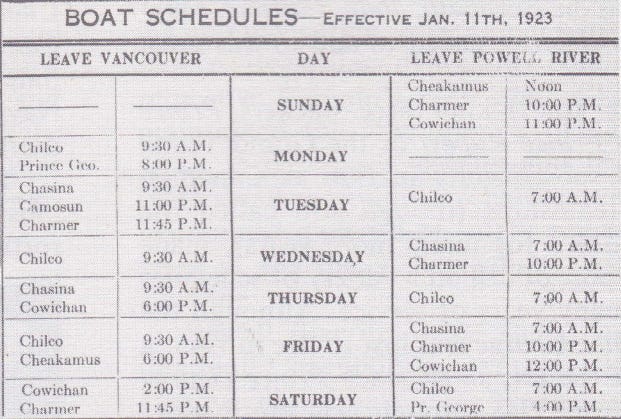
To get to the city, all you had to do was walk down to the dock, hop on a boat, kick up your feet, and a few hours later arrive in downtown Vancouver. A round trip was only two dollars (roughly thirty dollars adjusted for inflation).
For local travel, there were plenty of buses. The earliest bus service on record was started by a guy named Jack Dykes, back in 1923. He drove a truck with wooden planks for seats back and forth between Cranberry and Townsite. A few years later, Tom Peck and Roy Compton introduced a slightly classier option with a touring car that could carry nine passengers. In 1927, Joe Bigold started a service to Wildwood.
For much of the city’s history, bus services were privately run, and it’s hard to keep track of all the different companies that operated over the years. There was the Powell River Transportation Company, Malaspina Stages, Powell River Stages, Veteran’s Transfer, Powell River Bus Lines Ltd, and the Powell River Transit Company. With all the different options, buses were cheap, frequent, and the main way people got around town. As Peggy Bird remembers, “riding the bus was a way of life in Powell River then, and kept you in close touch with your neighbour.”1
But by the middle of the twentieth century, things were changing. Private cars were becoming increasingly common, and the bus companies were struggling. In 1956, during its final year in business, the Powell River Transit Company served 52,000 fares a month.2 It wasn’t enough to stay afloat. The next year, they were forced to sell to Sechelt Motor Transport, and the new owners cut service in half.
It was clear that it wasn’t possible to make money running a bus service in Powell River anymore. So, in 1968, the city council passed Bylaw 549, establishing a municipally-owned and operated bus service. But it was more life support than an attempt to revive the glory days of public transit.
Today, even though the city’s population has grown, our municipal bus service only serves 21,000 fares a month.
In other words, bus ridership in Powell River has dropped over seventy per cent since the late fifties. If we had similar stats for the number of people who walk or bike places, I suspect it’d tell a similar story.
What happened?
“Mr Gordon was always talking about a road to Vancouver some day, and we all thought he was crackers. He had great vision. He was into buying property (Gordon Park Subdivision). He knew what Powell River was going to end up like.”
- Ivy Richards3
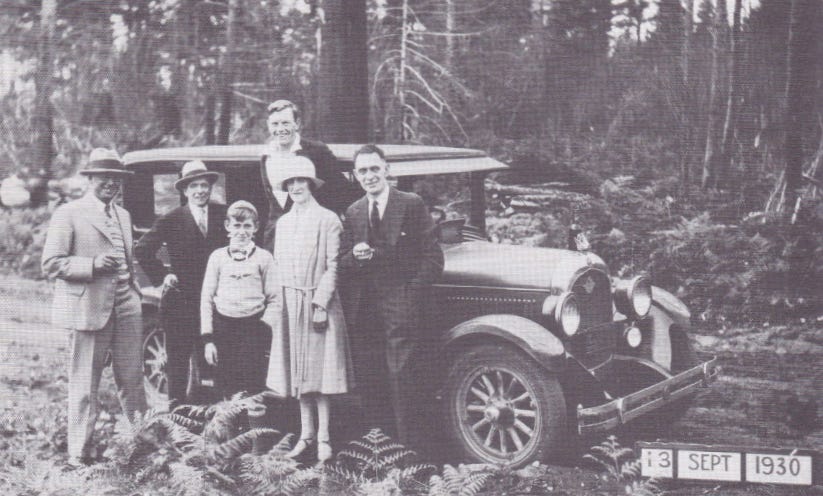
In 1917, a jeweller in Cranberry, Geo Somerton, bought a shiny black Ford Model T. It was the first car in Powell River.
At the time, there were only two roads, and cars didn’t have much purpose other than a way for businessmen and upper management at the mill to flex on each other.
Few people understood the central role the private car would soon play in Powell River better than Emil Gordon - by all accounts, one of the city’s most eccentric and visionary businessmen. In 1927, he opened Gordon Motors on Arbutus Street, the city’s first car dealership. During its opening month alone, he sold an impressive thirty-six cars. Soon, his operations expanded to include an automotive parts store, two mechanic shops, real estate development, and a second dealership - Motor Traders in Westview.
For the most part, all the new cars were a good thing. The city grew as new neighbourhoods opened up beyond the Powell River Company’s stuffy townsite. Cranberry benefited most of all, growing into a wealthy suburb. As the late Gerry Grey, former city councillor and editor of the Powell River News, explains:
“Perhaps the most significant event that ensured Cranberry’s future was the start of the Cranberry Road, connecting Poplar Street in the Townsite to what was to become the main street of Cranberry. If anyone today complains of potholes, they should know what their forefathers put up with on the road to Powell River. It was built over mud and sand. Over the bog at the top of the hill 18-foot cedar blocks were put down to add some stability to the road. Planks were laid over the mud and when it rained these boards became rafts. If a driver let his vehicle slip off a plank it was a days’ work to get it back up. However, it was a passageway no matter how crude, and commercial vehicles were able to access scows and barges to take their wares to the marketplace. The road worked the other way also and new entrepreneurs started businesses that flourished as the area population increased.”
By the mid-twentieth century, wages at the mill were high, and shifts were short (especially compared to the $0.22 hourly wage and 13-hour shifts that were standard at the start of the century). For the first time, workers had a surplus of time and money.
So, they bought cars. By 1947, Powell River allegedly had more cars per capita than any other Canadian city.4 Car ownership quickly became entrenched as a rite of passage and a way of life for a new generation of Powell Riverites. As a local Canada Employment officer described it during an interview in 1990:
“Eighteen to forty years ago in this town, kids went through school, dropped out of school, somewhere around grade ten. Went to work for the mill. Bought themself a big car and had a great time. That was the pattern. Their fathers, their grandfathers, all worked for the mill. They knew once they finished school, whatever that meant, when they reached working age for the mill, which was probably about sixteen at the time, they could drop out of school. And go and work in the mill and earn good money.”
It’s important to note that Powell River’s obsession with cars didn’t come from nowhere. It was encouraged at every level by government, industry, and even local community groups. If some cars were good, more cars could only be better.
Locally, one of the biggest champions of car culture was the Powell River Chamber of Commerce. For years, they worked tirelessly to promote Emil Gordon’s dream of a road to Vancouver.
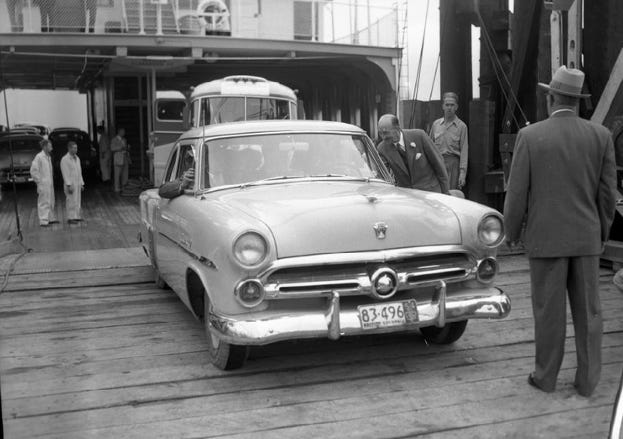
In 1954, their efforts paid off when the vehicle ferry from Saltery Bay to Earl’s Cove opened, connecting Powell River to the lower coast and, by extension, Vancouver. The American for-profit company that operated the service, Black Ball Ferries, gave the BC government a $500,000 interest-free loan to pave the road from Madeira Park to Earls Cove.
Cars started flooding in. The new service was such a success that Black Ball added another ferry in 1965 (the Comox Queen) with daily service between Powell River and Comox. Still, the Chamber of Commerce kept pushing for even more cars. They shifted their focus to promoting the Coastal Circle Route, encouraging road-tripping tourists to drive to Powell River.
It wasn’t just the Chamber of Commerce that thought bringing in more cars would usher in a new era of wealth and prosperity. City council got swept up in the car-mania, too.
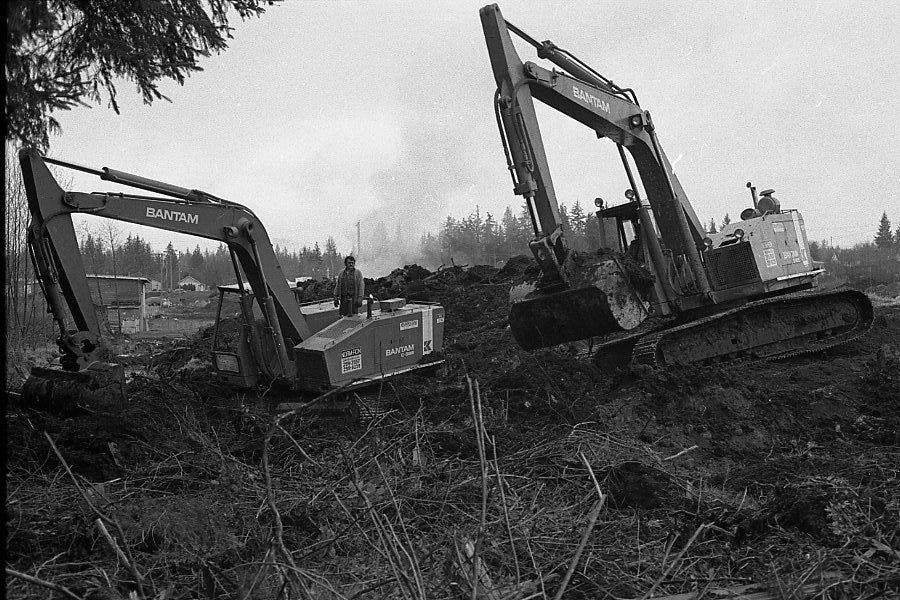
While the ferries were getting built, the city council introduced new car-centric laws and green-lit expansive suburban developments, baking sprawl into the fabric of our city. To this day, city bylaws require every new home to have at least two dedicated off-street parking spaces. Retail stores are required to have a parking space for every 250 square feet of floor space - effectively making strip malls and box stores the only type of commercial space anyone’s allowed to build. The city cut perfectly straight, forty-foot-wide streets through Westview’s new residential neighbourhoods and set the speed limits dangerously high. For decades, they underfunded pedestrian infrastructure, bike lanes, public transit, or any alternative to car travel.
In some ways, and for some people, one could say that Powell River changed for the better. Cars can rip across town in under ten minutes, there’s never any traffic, and, no matter where you go, there’s always free parking.
but, was the juice worth the squeeze?
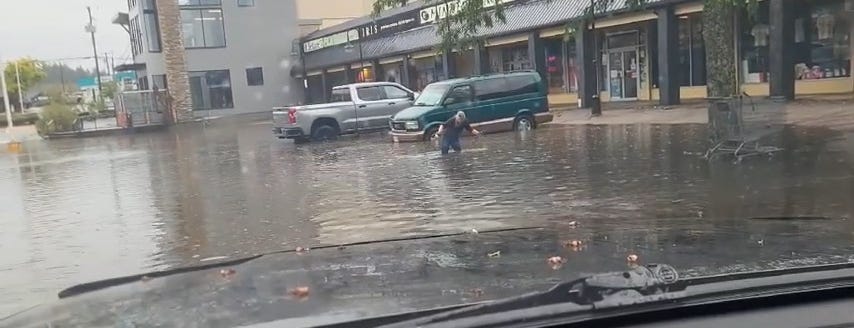
Turns out, paving over the city and laying out the red carpet for big corporate box stores had some unintended consequences.
Slowly but surely, Westview’s new developments sucked the life out of Powell River’s historic downtowns. Locally owned stores that had been in business for generations closed, one after another - they couldn’t compete with the convenience of Joyce’s easy parking and one-stop shopping. The sturdy old homes of Townsite were neglected and fell into disrepair. People started calling Cranberry, Crackberry.
It’s not like no one saw it coming. As Gerry Grey describes it,
The village of Cranberry Lake was dragged, kicking and screaming into the 1955 amalgamation of the four communities (Westview, Townsite, Wildwood) to form the Municipality of Powell River. The reason for the reluctance was that Cranberry had $4,200 in the bank and the other three had none. Therefore, the question was “What’s in it for us?” For 10 years after the event, village seniors met every Saturday morning at Jack Hanna’s Quality Printing shop to bemoan the loss of Cranberry’s independence and how the folks in Westview were ripping them off. The same complaints were aired monthly at the Cranberry Ratepayers Association meetings. However, most were ignored at the council table.
The strange thing is, even with money pouring into Westview’s new developments, property values never quite caught up with the old neighbourhoods. Today, land values on Joyce are forty per cent lower than land values on Marine, Westview’s historic downtown.
The mismatch in property values has some serious implications. It means that businesses on Joyce aren’t paying their fair share in taxes.
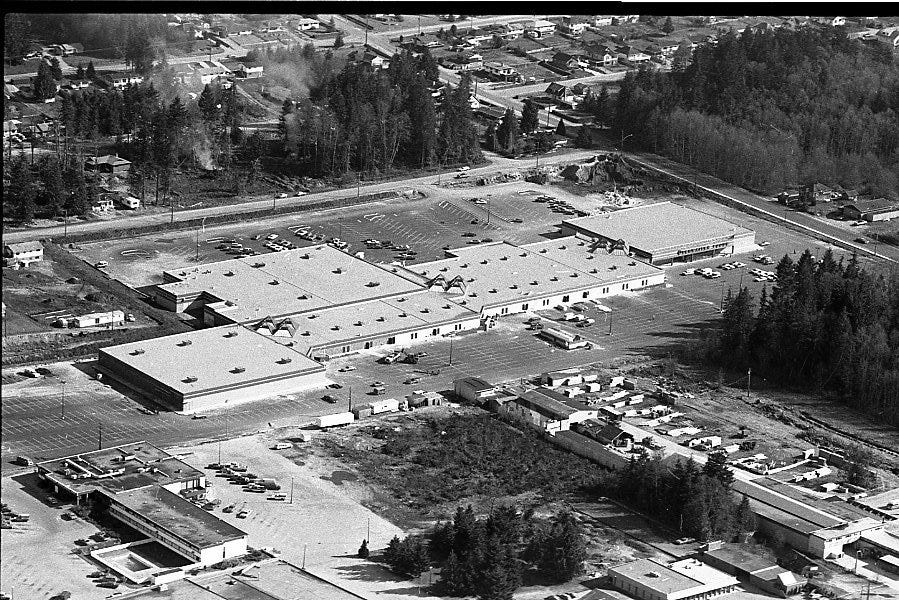
For example, the Town Centre Mall (whose tenants include Walmart, Canadian Tire, and Starbucks) pays roughly $26,000 per acre in property tax. In comparison, a building on Marine that hosts three local businesses (32 Lakes Cafe, Wild Scoop, and Ecossentials) pays $153,000 per acre in property tax - a whopping six times more than the Town Centre Mall!5
There’s no valid reason for the discrepancy - it’s just a quirk of municipal taxation that corporations have learned to exploit. Strip malls and parking lots bring down property values, and their owners are taxed less because of it.
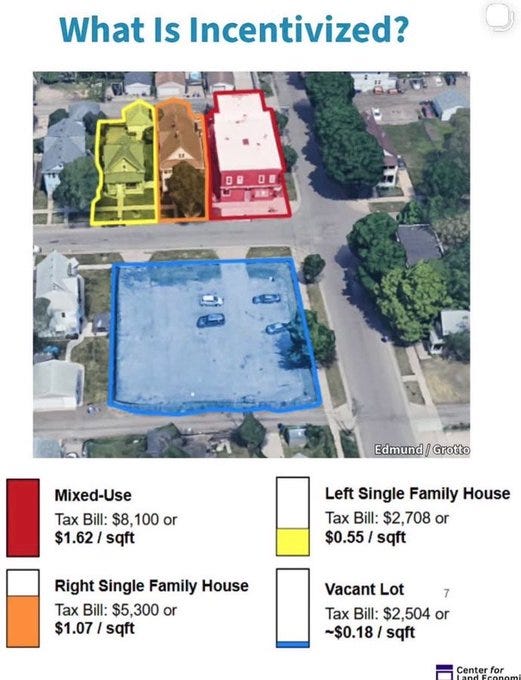
But the city’s expenses don’t scale with property values. Whether an acre of land supports one mega-mall or thirty local businesses, they need the same city services - sewer pipes, water lines, landscaping, street lighting, road maintenance…
Ever since it was built, Joyce Ave has been subsidised by the rest of the city. It’s a cancerous leech. It’s the spawn of one of those freaky spiders whose young eat their mother, cannibalising the old neighbourhoods that birthed it.
It sucks so hard.
Its endless parking lots are scorching hot in the summer and flood in the winter, its traffic is loud and dangerous, its sprawl makes us isolated and lonely; its hostile architecture demands that we drive, making us poorer, contributing to our accelerating climate catastrophe, and fuelling community collapse.
With such wide-ranging downsides, it’s worth asking:
who does Joyce Avenue actually benefit?
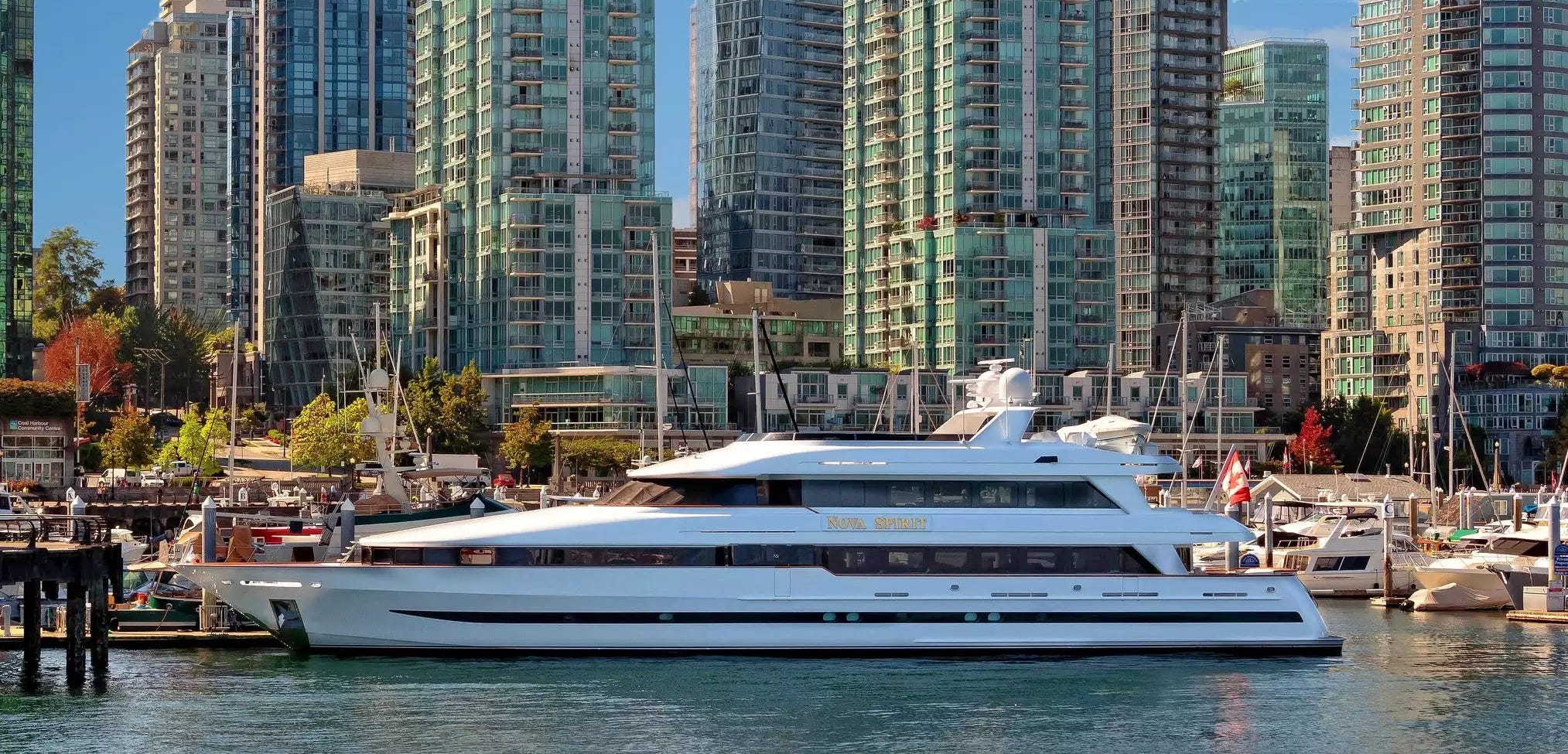
More than anyone else, it benefits Jimmy Pattison, the richest man in British Columbia. Jimmy owns Save-On-Foods, Quality Foods, and the Town Centre Mall. With over forty commercial tenants and 250,000 square feet of retail space, his mall has been the commercial heart of the city since it opened in 1981.
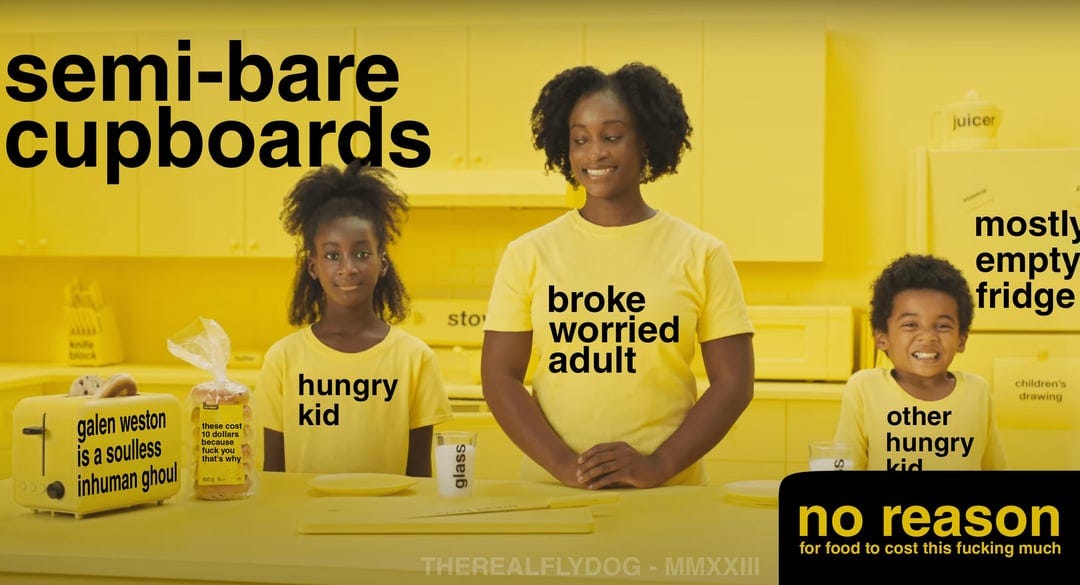
He isn’t the only multi-billionaire profiting off of our community. There’s also Galen Weston, who owns Shoppers Drug Mart and No Frills. But, mostly, Joyce Avene is a tangled rats nest of American private equity firms - BlackRock, (McDonald’s, Starbucks, Chevron), Roark Capital Group (Anytime Fitness, Subway), Sycamore Partners (Rona, Staples)...
Their stores are so absurdly convenient and have such a hold over this town that it’s nearly impossible not to give them your money. The Town Centre Mall is surrounded by over eighteen acres of free parking, has four drive-thrus, and six of the city’s seven bus routes connect out front in the town centre exchange.
I love a greasy drive-thru as much as the next guy, but they’re robbing us blind.
According to a recent study, for every $100 we spend at a local business, $63 stays in the local economy. In comparison, when we spend $100 at a multinational corporation, $86 leaves the local economy.
In other words, a handful of multi-billionaires and faceless American private equity firms are extracting ungodly amounts of money from our community every single day. And they’re not even paying their fair share in taxes.
how do we free ourselves from the vampiric grasp of Jimmy, Galen, and their ilk?
If you buy coffee at Starbucks or cheap groceries from Walmart, don’t be too hard on yourself. Where we shop isn’t so much a personal choice as the result of decisions made by generations of city planners decades ago.
They had no way of knowing the corporate hellscape they were unleashing.
Inspired by what other cities are doing across the province, I’ll leave you with a list of ideas for how Powell River could repair the damage caused by Joyce Ave. To prove they’re possible, I’ve included examples of some big-balled municipalities that have enacted each reform.
Lower municipal speed limits from 50 to 30 km/h. This would reduce traffic noise by half and lower the likelihood of pedestrians dying in a crash from 80 to 10 per cent. (Tla’amin Nation, Whistler, Duncan)
Decrease lane widths. Wide lanes encourage speeding and are significantly more dangerous than narrow lanes. The extra space could be used for protected sidewalks, bike paths, or shade trees. (Victoria, Port Moody)
Remove mandatory parking minimums for new construction. A study from Vancouver found the true cost of a single parking stall can be as high as $137,000. It’s an easy intervention that would make new housing more affordable and encourage density. (Vancouver, Nanaimo, Delta)
Tax off-street parking lots. Joyce’s empty sprawling lots are a blight on this town and keep property values artificially low. Vancouver uses its parking tax to fund public transit. (Vancouver, Langley)
Ban drive-thrus. Encourage people to support local restaurants, leave their cars, and connect with their community. (Squamish, Kimberly, Nelson)
Free public transit for youth. Kids can’t drive and don’t have money. They deserve the right to travel (Victoria, Penticton, Nanaimo)
Invest in revitalising main streets. Improve pedestrian infrastructure, support local businesses, highlight local culture, and keep money recirculating in the local economy. (Nelson, Ladysmith)
Municipal gas tax. Drivers who use road infrastructure should be the ones paying for it. Use the revenue to fund public transit and pedestrian infrastructure. (Bowen Island, Victoria, Vancouver)
quoted in Karen Southern & Peggy Bird’s Pulp, Paper, and People
ibid
ibid
ibid
The Town Centre Mall property is 19.7 acres and is assessed at $29,046,000. With a 1.77% retail property tax = total tax of $515,764 or $26,180 per acre. 6812 Alberni Street is 0.098 acres and assessed at $846,000. A total property tax of $14,022, or $153,288 per acre.
This reminded me of something that has been going on at a grander scale and hasn't slowed down, which is the homogenization of everywhere. The local is being displaced by the global / corporate / multi-national. The unique replaced by the uniform. The beautiful replaced by the bland. Everywhere is predictable, safe, consistent and ultimately dull. It's the box-storeification of communities at all scales, across our province, country, continent (and likely the western world).
There is a great book on the subject called Real England by Paul Kingsnorth that dives into all the elements of english culture that have been lost/dissolved by globalisation. Your article reminded me of the same thing. It's hard not to read this and come away feeling like something special has been lost...
Great work, keep it up.
As a relative newcomer (5 years) who lives on Joyce, I read your article with great interest. Such a great description of 'the good old days'! I couldn't agree more with every recommendation you made... starting with reducing the speed limit to 30k/hr on Joyce and making this main artery more friendly to kids, seniors and cyclists. If you plan to run for mayor, you have my vote! :-)