


Powell River is named after Israel Powell, British Columbia’s first superintendent of Indian Affairs. It’s an awkward thing. The city is in the middle of Tla’amin territory, a coastal First Nation whose territory stretches from Lang Bay to Cortes Island.
Understandably, some people are uncomfortable with the city’s name. After all, Powell was a die-hard assimilationist, a supporter of BC’s residential school system, and a notorious thief of Indigenous ceremonial and sacred belongings.
So it wasn’t too surprising when, back in 2021, Tla’amin Nation formally asked the City of Powell River to change its name.
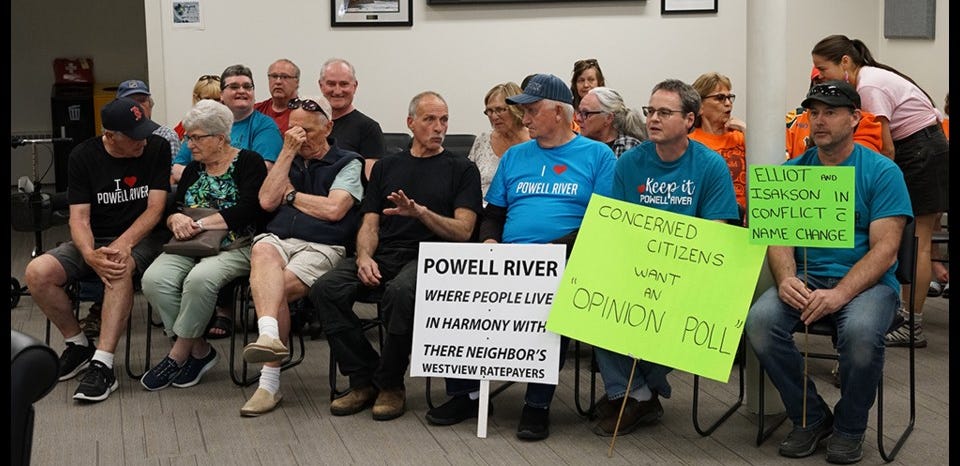
Still, locally, it was a big deal. It quickly turned into a fight over history and how we understand it.
A group formed to resist the name change, calling themselves the Concerned Citizens. They felt they were being made ashamed of their heritage. A rival group, The Name Matters, was formed to educate people about colonization and advocate for inclusive place names.
With battle lines drawn and two sides entrenched in their positions, the name change decision became a political hot potato, hucked further and further down the road. The city hired consultants and organised public engagement meetings. But nothing really happened. After a few years of inaction, the issue seemed to slowly fizzle out. People’s focus moved on to other issues facing our community.
Until recently.
At a meeting on February 5, the mayor revived the issue with a seemingly innocuous proposal that “Council postpone any further action regarding the request to change the name of the City of Powell River” until a new council is elected.
The crowd that showed up for the meeting was inexplicably fired up and ignored multiple calls for order. Their disruptions continued until the mayor ordered the RCMP to kick them out. Still, they refused to leave. Council was forced to move their meeting to a private room, only allowing the public to watch via livestream.
For some reason, the dial on public discourse in this town has been cranked all the way up to eleven. Senior citizens are flirting with civil disobedience, yelling at city councillors, and spamming social media with personal attacks. They’re convinced this is their Tiananmen Square.
how did shit get so weird?
A few years ago, the grievance-media machine caught wind of the controversy around Powell River’s possible name change. It has all the elements of a good story, or at least the kind that seems to resonate well with a certain demographic. Indigenous overreach, woke authoritarianism, wasted tax dollars…
So, fishing for engagement, shoddy journalists started chumming the already muddy waters with more and more inflammatory content.
Frances Widdowson, a former professor at Calgary’s Mount Royal University who was fired for harassing her colleagues, published a YouTube documentary called WHAT REMAINS: Exposing the Kamloops Mass Grave Deception’s Impact on Powell River. Juno News, founded by Candice Malcolm and white supremacist Keean Bexte, published articles like Powell River’s nasty name change debate and reconciliation used to bypass local democracy. C2C Journal published a weighty thinkpiece, Collaboration No More: How the Powell River, B.C. Name-Change Debate Turned Nasty. Rebel News wrote a revisionary hagiography of Ted Vizzutti — an elderly paramedic fired for his racist Facebook posts — called, hometown hero called racist and cancelled from paramedic duties after advocating to save Powell River’s name.
Somewhere along the line, the name change debate stopped being a local issue.
Justice Centre for Constitutional Freedoms
The third time the Justice Centre for Constitutional Freedoms (JCCF) got involved, I started thinking to myself – someone’s got to be funding this.1 JCCF is a Calgary-based legal advocacy group founded and run by John Carpay, a former lawyer who was disbarred in both Manitoba and Alberta for spying on a judge back in 2021.
Their first time dabbling in Powell River politics was in June 2024, when Diane Sparks (a local realtor) booked a library space to host an anti-name-change event. The library hesitated, saying they would need consent from city council before confirming her booking. Suspicious that the library might be considering cancelling Sparks’ booking, the JCCF sent the chief librarian a warning, “urging the Library to respect citizens’ Charter rights.”
The library allowed the event to go ahead.
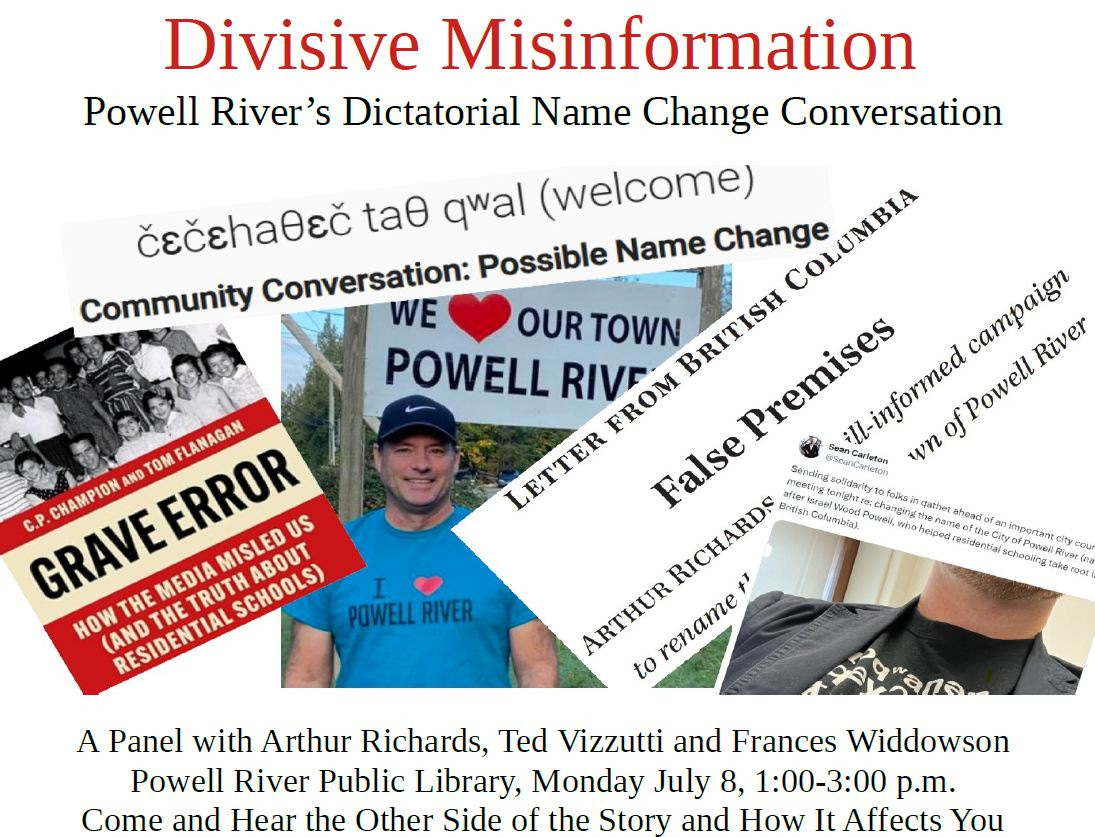
Two months later, JCCF followed up with a strange, exhaustive fifty-six-page legal letter to the city.
It was a serious escalation, accusing council members of silencing dissent and violating citizens’ Charter rights. It claims “that Council appears to have largely lost its legal jurisdiction in connection with the name change.” Amazingly, it claims that four of Powell River’s six councillors are “irredeemably biased” and “must recuse themselves from further debate and decision-making in connection with the name change.”
Last week, JCCF sent another letter to the city, reiterating its demand that “council fundamentally alter the manner in which it is approaching the Tla’amin Nation’s demanded name change.”
The thing about lawyers is, even if they’re ineffectual, they’re still expensive.
who’s paying?
The Justice Centre for Constitutional Freedoms is a registered charity, funded by private donations. They’ve got eight full-time staff, an annual operating budget of over $5 million, and received over $2.3 million in donations in 2024 alone.
The Canada Revenue Agency doesn’t require charities to disclose where their funding comes from. So, unless they get audited, it’s next to impossible to figure out who’s donating to the Justice Centre. But there are clues. JCCF has disclosed to the CRA that it received donations valued at $10,000 or more from donors outside of Canada. At least some of that (and likely more) is coming from the American-based think tank that creates think tanks - the Atlas Network.
It’s something they try to keep on the down low. For a long time, the JCCF was listed on the Atlas Network’s website as one of their “Global Partners.” It’s since been removed. One of their former directors, Marco Navarro-Génie, is a former Atlas employee. Carpay himself admitted back in 2015 that, “we have a small annual grant from Atlas.”
the Atlas Network
The Atlas Network was founded in 1981 by Antony Fisher. Born in 1915 to a wealthy coal mining family, he grew his family fortune into next-level riches when he introduced battery cage poultry farming to England.
By cramming chickens into tiny cages, he managed to eliminate wasteful behaviours like wing flapping, dust bathing, and foraging. Feed needs went down twenty-five percent. Floor space by seventy percent. Fisher started raking it in. His competition, still practicing traditional free-range farming, had to hop on board with the new way of doing things or go belly up.
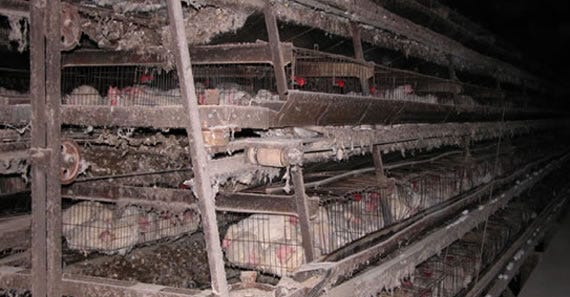
Things went well for Fisher until the Second World War shook things up. He started getting nervous about the emerging post-war consensus that favoured strong unions, heavy regulation, and high taxes. It went against his values and threatened his growing profits. So, he tried to change society’s mind. He started pumping his considerable wealth into free-market, small-government propaganda.
In 1955, he founded the Institute of Economic Affairs in London. In 1974, he founded the Fraser Institute in Vancouver. By the time he was an old man, Fisher had a dozen think tanks to his name, spreading his neoliberal gospel around the world. In 1981, he created the Atlas Network in San Francisco to connect them all into a coordinated, international network.
a not-so-shadowy cabal
In Powell River, the Justice Centre for Constitutional Freedoms is just the tip of the Atlas iceberg. Once you know to look for it, it’s hard not to notice their grubby little fingers tugging away at every loose thread in the city’s fraying political fabric.
Dr. Frances Widdowson, a well-educated political scientist, has emerged as a leading voice against the city’s name change. Since getting fired, she’s been on a crusade against wokeism and what she calls the Aboriginal Industry. Her essay in the influential and controversial book, Grave Error, was published by True North. She gets legal support from JCCF, documentaries produced by Juno News, and articles published by the C2C journal.
All of which are connected to the Atlas Network.
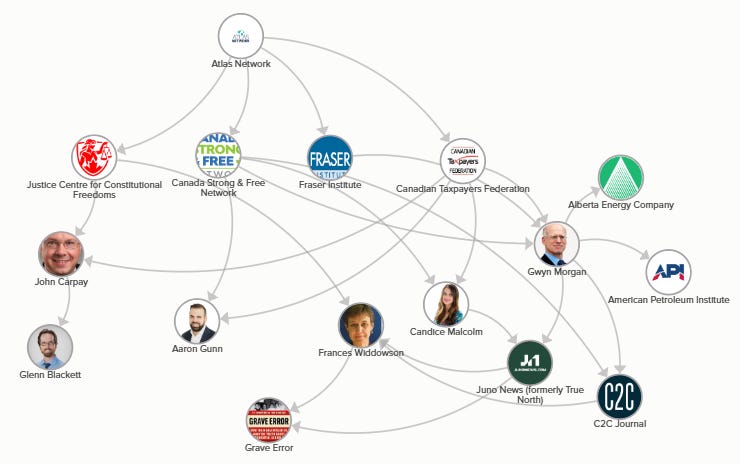
The C2C journal is a partner in the Canada Strong & Free Network (formerly the Manning Centre), a think tank founded by Preston Manning. Readers might remember Manning as the founder of the Calgary-based Reform Party, an anti-establishment populist party focused on Western alienation. Manning’s stated goal is the creation of a coalition corridor. He’s orchestrating a “co-ordinated response from governments, companies and Canadians” to get pipelines built from the Pacific to the Atlantic to the Arctic.
Gwyn Morgan, named “the most powerful man in Canada’s oil patch” by Maclean’s magazine, sits on the journal’s board. Their editor-in-chief, George Koch, used to work as a speechwriter for Alberta’s Minister of Energy. Significantly, the Canada Strong & Free Network lists the Atlas Network as partners on their website.
Juno News (formerly the True North Centre for Public Policy) is a Calgary-based charity, founded by Candice Malcolm. Before founding Juno News, Malcolm spent eleven years working at the Washington DC based Center for a Secure Free Society, a branch of the Atlas Network. Notably, oil tycoon Gwyn Morgan also sits on the board and has donated at least half-a-million dollars of his own money to the organisation.
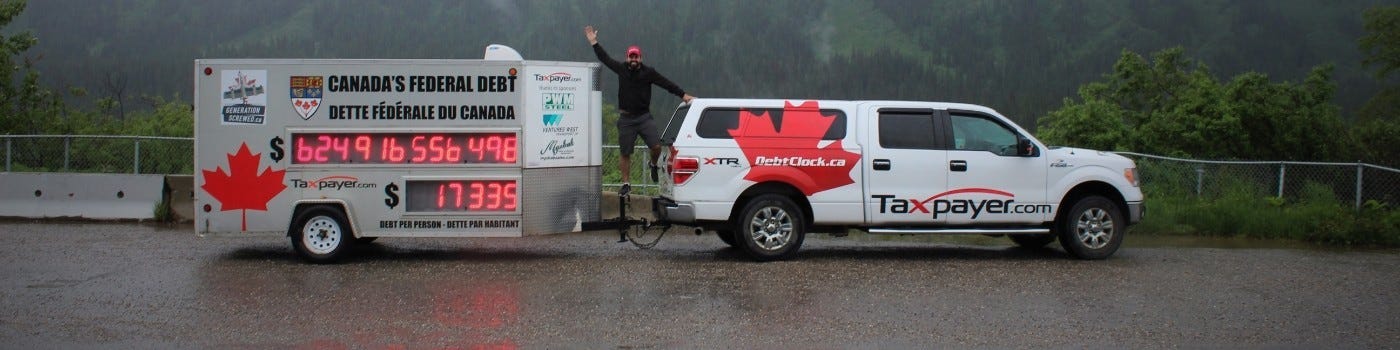
The Canadian Taxpayer Federation is another member of the Atlas Network that’s active locally. Most prominently, it helped launch Aaron Gunn’s career - promoting him to executive director of their Generation Screwed campaign in 2013, where he taught students about the wonders of deregulation and organised youth leadership retreats with the Manning Centre in Calgary.
John Carpay, founder and president of the Justice Centre for Constitutional Freedoms, spent four years as the Alberta director of the Taxpayer Federation. He’s a great example of how permeable boundaries are at the Atlas Network. He’s a member of the Canada Strong & Free Network, a regular contributor to the Fraser Institute, the C2C journal, Juno News, and a former candidate for Manning’s Reform Party.
The Atlas Network, the big boys behind it all, have a long list of powerful backers that you can read about here. To summarise, it’s all the usual suspects: fossil fuel magnates, finance bros, hedge fund managers, and big tobacco. Prominent donors include Exxon Mobil, Philip Morris, and the Koch family.
So, we have an idea of who is funding the name change hysteria. But why do American billionaires and Alberta oil executives want to get people in Powell River riled up about what we call our town? What do they gain by fracturing our community?
Wexit and the BC Prosperity Project
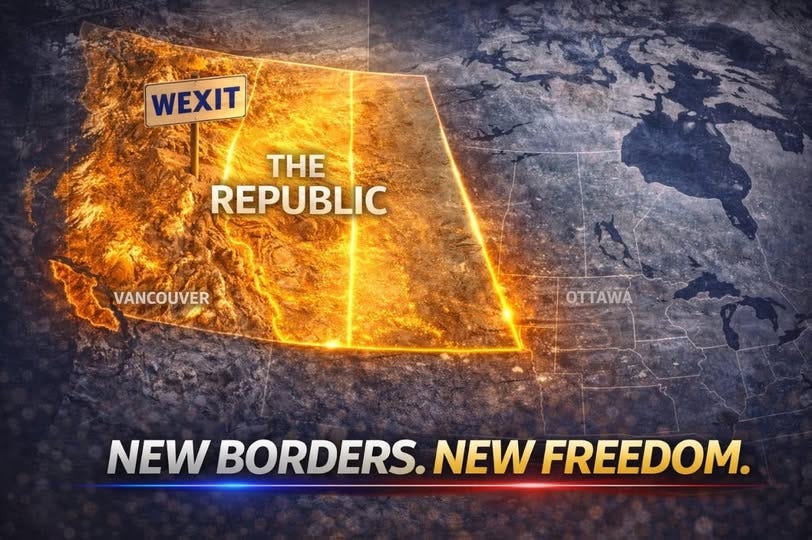
The Atlas Network isn’t secretive about what it wants. Limited government and unregulated industry. They dream of a world where corporations can do what they like, unencumbered by Indigenous rights, labour laws, or environmental protections. They’re clear that:
“The Atlas Network vision is of a free, prosperous, and peaceful world where the principles of individual liberty, property rights, limited government, and free markets are secured by the rule of law.”
In pursuit of their vision, they’ve perfected a time-honoured strategy. Divide and conquer.
Six years ago, The Guardian wrote an exposé called, How the right’s radical thinktanks reshaped the Conservative party. It explains how Atlas managed to infiltrate Britain’s Conservative Party, set the national agenda, and even place its members into key positions in Boris Johnson’s cabinet.
Their goal? Britain’s exit from the European Union - aka Brexit.
In 2017, three years before the UK officially left the EU, Atlas published an article in its magazine, Freedom’s Champion. In shockingly candid terms, it explains how “Brexit provides us with a once-in-a-generation opportunity to radically trim the size of the state and cut the regulatory burden.”
So, I don’t think I need to put on my tinfoil hat to say - it looks like they’re doing the same thing here.
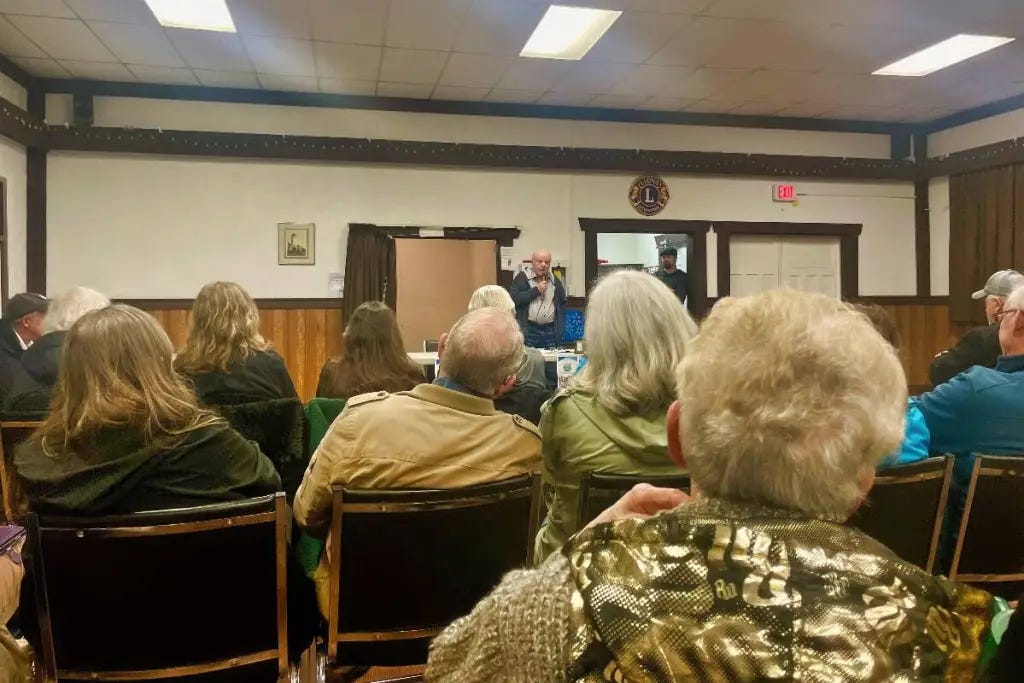
On February 3, the BC Prosperity Project hosted its inaugural event in Campbell River. It had a mediocre turnout - about a hundred people reportedly showed up. But their Facebook page, created just two weeks ago, already has over sixteen thousand followers.
The BC Prosperity Project is BC’s chapter of the Alberta Prosperity Project, a group trying to get Alberta to secede from Canada. Their vision is for Alberta (and also BC and Saskatchewan?) to become “the least governed, least regulated and lowest taxed nation in the world.”
Despite getting called out by a fellow Member of Parliament to “clarify [his] position on separatism,” Aaron Gunn has refused to condemn the event in his riding.
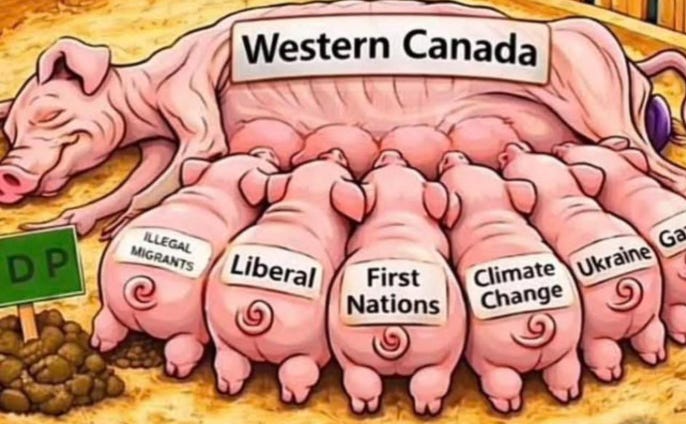
Aside from Gunn’s apparent ambivalence toward treason, there are other hints that the Atlas Network might be behind the sudden uptick in separatist propaganda.
Bruce Pardy, a professor of law at Queen’s University and a board member of the Justice Centre for Constitutional Freedoms, recently published a thirteen-page legal manifesto in the C2C Journal. It’s called “Articles of Freedom: The Blueprint for a Stateless Alberta.” Notably, in his utopian vision for the province, Aboriginal title is erased, and former reserves are transformed into private property.
here’s my theory:
The controversy around Powell River’s name change is being used as a building block in a narrative that’s becoming increasingly mainstream. The idea is that Indigenous rights are being used as a smokescreen by a global Marxist elite. Powell River being forced to adopt an Indigenous name is another step down a slippery slope that’s leading us toward authoritarianism, the abolition of private property, and the end of representative democracy.
That’s what the Concerned Citizens are fired up about. That’s why city council meetings are growing increasingly hostile and toxic.
The Atlas Network's aggravation of the name change debate is a small part of a broader strategy to create, seek out, and amplify division across the province. Their goal is to destabilize government and give extractive industry unrestricted access to our resources.
American billionaires and Alberta oil and gas executives don’t particularly care what we call our city. It just happens to be a wedge issue that keeps us divided.
(my girlfriend and proofreader has corrected the record, that she thought of this first)
Excellent work Craig! I'm so glad you're exposing the foreign network inserting themselves into what is and should be, a local issue, decided by local people. By attacking elected city councillors, the small, vocal minority of anti-name-change people are simply demonstrating their anti-democratic bonafides, and as that photo in council chambers demonstrates, serious deficits in there (SIC) intelligence. It's confirmation bias on fucking steroids. As for Aaron Gunn: we need to ensure that the 60%+ that voted against him do not split the vote next time.
I get the picture. The right and the far right are organized, very organized and well funded. They say you have to fight fire with fire, so it means we have to get organized. The article outlines the historical evolution of Atlas and it's power and how it's voice is the voice of a very powerful class. Someone realized that they who control the narrative will control the outcome. There are many narratives that have made Canada a liveable place (co-op housing, medicare for all among others) and have been ignored or countered by the likes of Atlas and the public and if they are not supported and fought for they will disappear and we all will wonder what hit us. Time to get control of the narrative.