


“You gave everything to the Indigenous, now you’re giving away our heritage building?”
Public input from Powell River’s Committee of the Whole Meeting, January 20, 2026.
Powell River hasn’t had an emergency shelter since March. Now, deep into a damp coastal winter, things have got pretty bad. Makeshift camps are visible across town, and people are sleeping rough with little more than cotton sleeping bags and cheap Canadian Tire tents. The new 40-bed temporary emergency shelter on Barnett Street, promised for this winter, is still under construction and likely won’t be open until March.
We all saw the problem coming. Just before the Christmas break, hoping to avert disaster and give some dignity to people living outdoors, the city council resolved “that staff be directed to activate city space in partnership with community partners to open a warming centre.”

With council's direction, city staff began looking for a building that could serve as a warming center. It needs at least two bathrooms, controlled access to outdoor space, and room for twenty beds. The city doesn’t own that many buildings, and the search was exhaustive. The staff’s report to council shows that the Rec Complex, Wildwood Firehall, units above the library, and even council chambers were considered as possible options.
But, as staff considered the logistical challenges, they found that most buildings don’t meet their criteria. They’re either too small, need additional staffing to make them secure, already leased to someone else, located in a residential neighbourhood, or are too far from services.
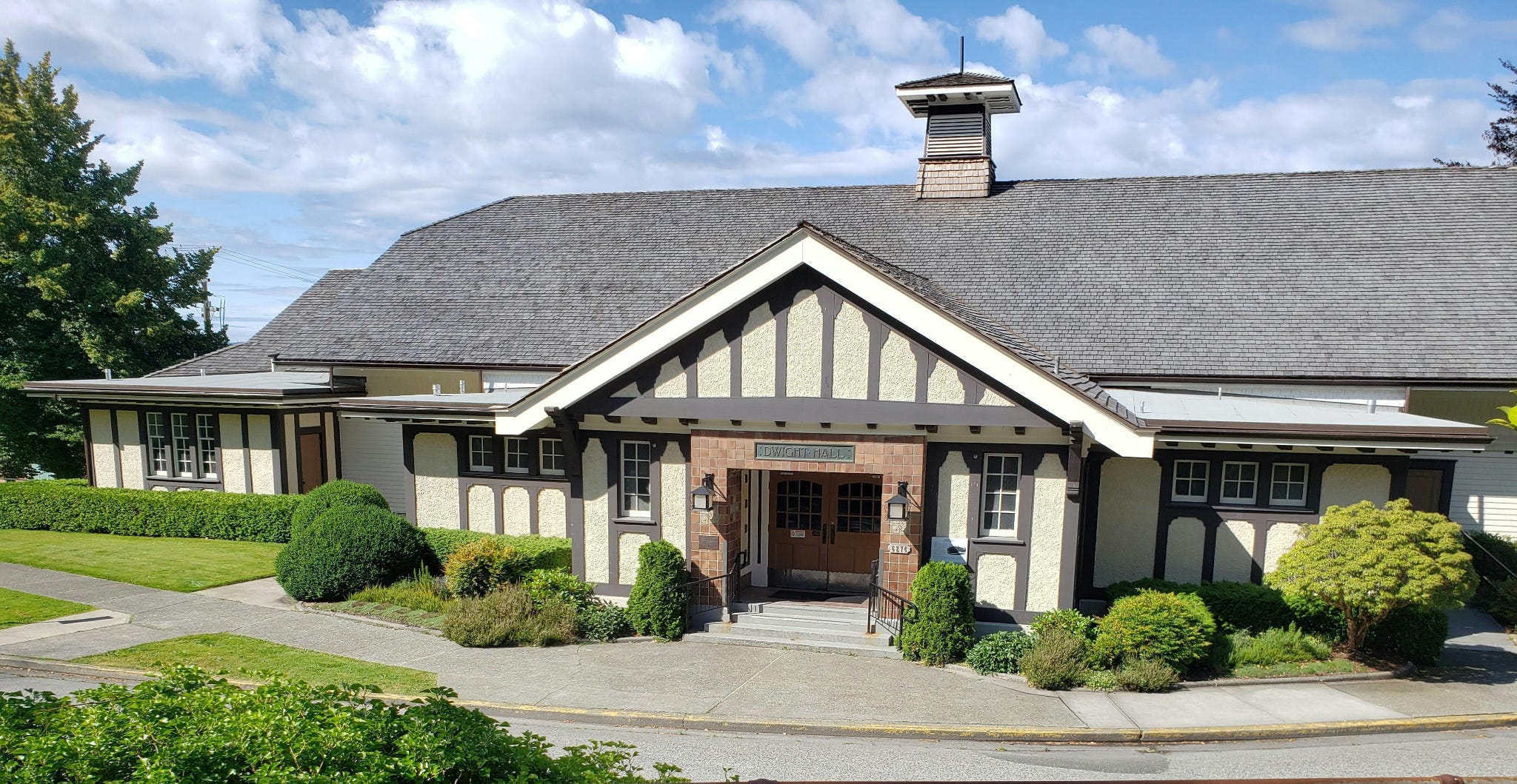
Ultimately, the basement of Dwight Hall emerged as the only city-owned building that checked all of the boxes for an emergency weather shelter. As the report explains,
“its location in Townsite is closer to the City’s central core where many of those experiencing homelessness are drawn to for other services. It is also further removed from schools and residential properties. Lastly, while it only has one washroom, the limited number of entrances (compared to the former Wildwood Firehall which has many) would make it much easier to manage the access and egress of guests.”
Once the city’s plan became public knowledge, the reaction was hot and fast.
not in my heritage building!
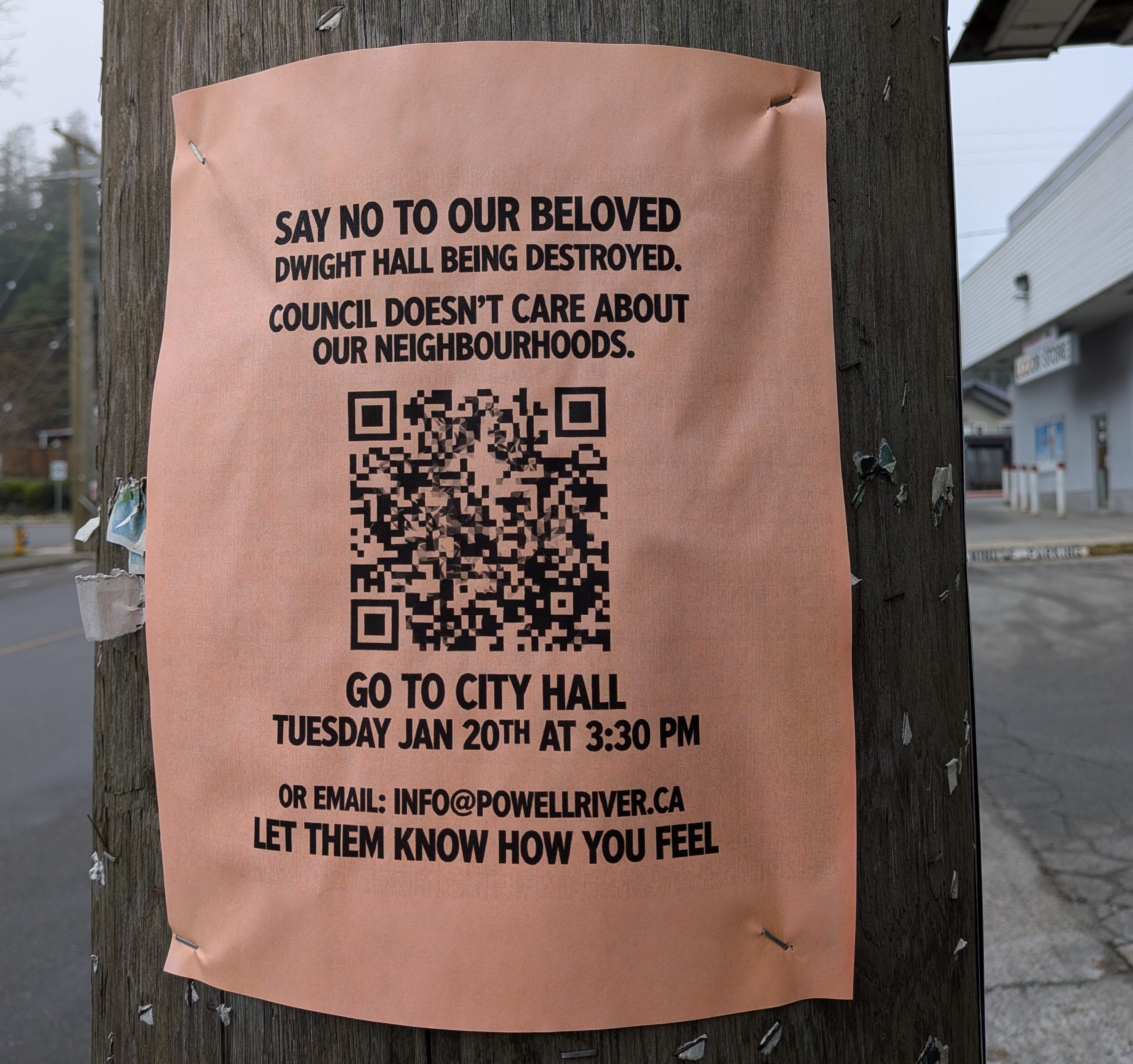
Powell River’s council meetings are usually a pretty mild affair. Not so on January 20, 2026.
During the Public Input Period, one person after another spoke against using Dwight Hall as an emergency weather shelter. The temperature of the room slowly rose to boiling. It culminated in one woman shouting at city councillors to “put them [homeless people] on a bus and get them the hell out of town.” Another man claimed, to wild applause, that the council is corrupt and someone’s slipping them cash under the table. When told to leave, he refused to step away from the podium and insisted on being removed in handcuffs.
Dramatic stuff.
Two days later, a petition called “Stop the Extreme Weather Shelter in historic Dwight Hall” was widely circulated. It explains that,
“Dwight Hall holds a special place in our hearts as a cornerstone of our community’s history and culture. Situated in the heart of our beloved small town, Dwight Hall has been the setting for countless cherished moments and serves as a cultural hub where we gather for various community events. From celebrating Remembrance Day at the cenotaph and singing Carols by Candlelight during Christmas, to hosting weddings that unite families, this historic building is woven into the fabric of our lives.”

It’s a beautiful picture. You can almost hear the harmonies of Joy to the World washing over the soft crackle of candle wicks. Not a crackhead in sight.
Diana Collicutt – president of Townsite Ratepayer Society and past director of the Townsite Heritage Society – added her voice to the chorus of those against the warming shelter. In her words, Dwight Hall was “built by the hands of community with more than just plaster and wood. Heart and soul have gone into this building.”
Diana, like many concerned about the inappropriate use of a heritage building, claims to speak for the generations past who built and left their mark on the hall. The problem is, she’s fundamentally mistaken about who those people were. Dwight Hall wasn’t built by innocent carolers and pearl clutchers who would leave their neighbours out in the cold.
Dwight Hall was built by socialists who fought to make housing a fundamental human right
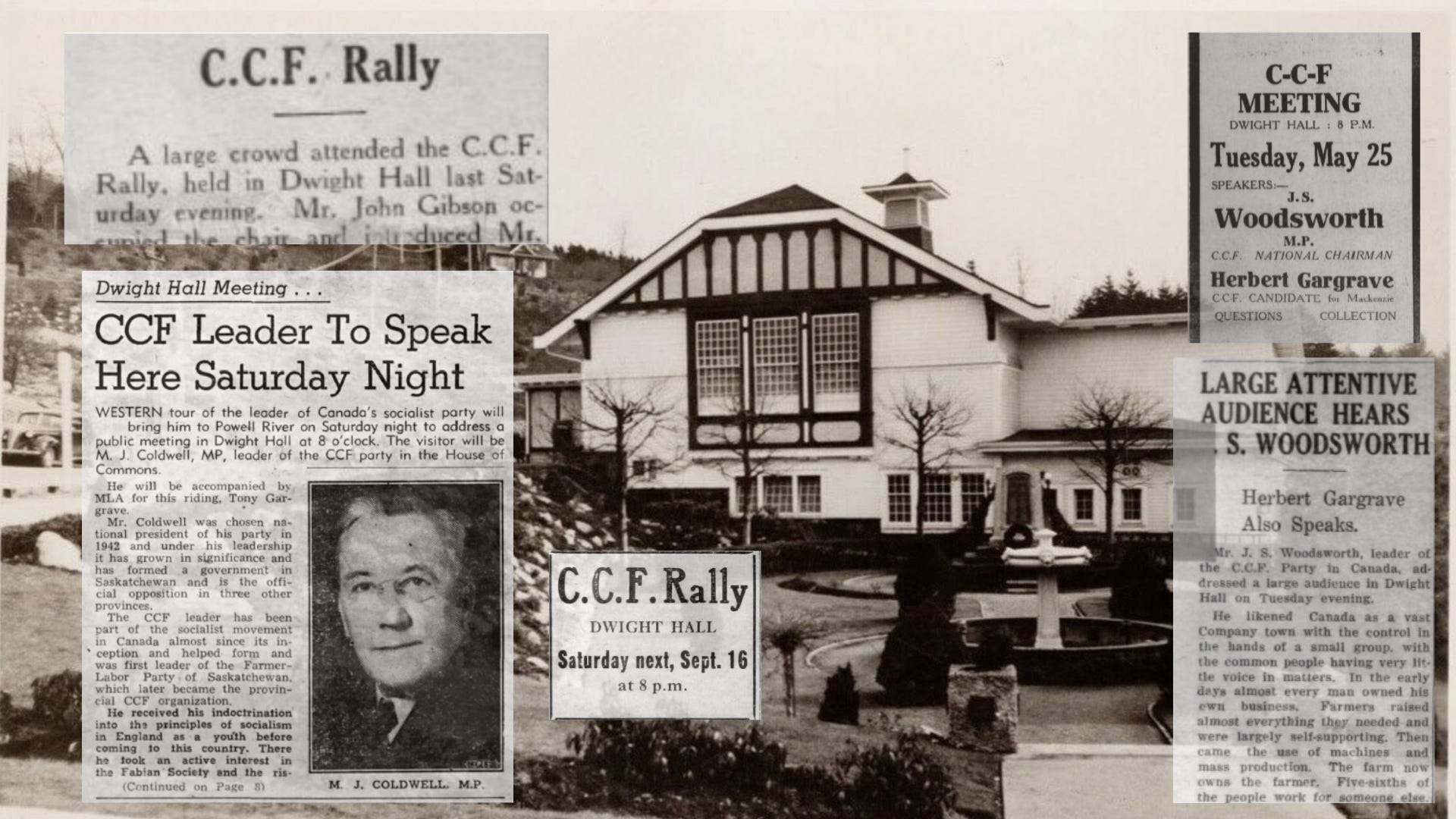
Dwight Hall was built in 1927, two years before the Great Depression. It’s named after the American lumber baron, Dr. Dwight Brooks, who founded the Powell River Company. For decades, he ran the company town with an iron fist from his headquarters in Minneapolis. Every attempt by the mill workers to unionise was crushed. Rebellious workers, along with their families, were regularly evicted from their homes and blacklisted from mills across the country.
Dwight Brooks may have paid for the hall, but the majority of workers who built it — the carpenters, electricians, painters — were socialists.
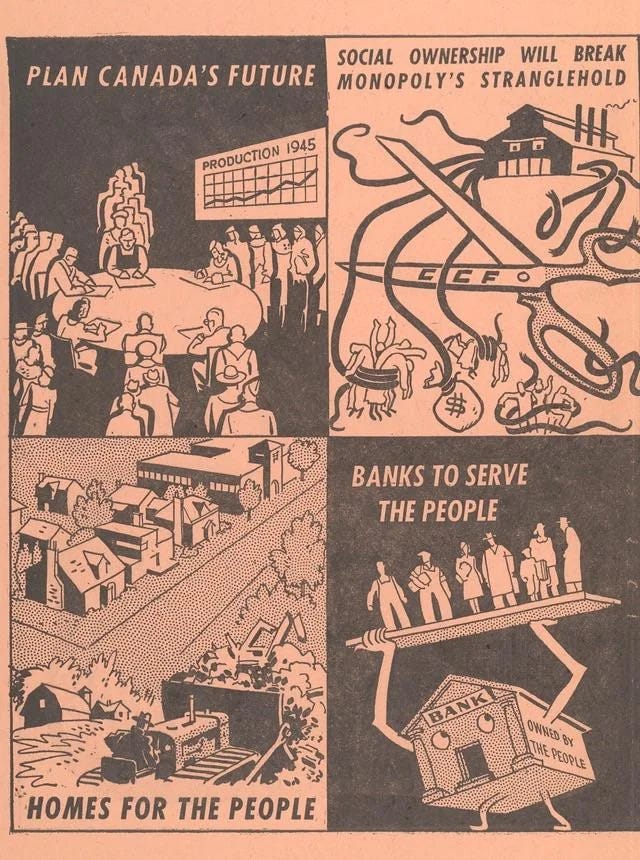
In 1932, the Socialist Party of BC joined forces with various labour and farmer groups to form a new party - the Co-operative Commonwealth Federation (CCF). Their goal was to fight back against the unchecked power of capitalists like Dwight Brooks. In their words, “no C.C.F. Government will rest content until it has eradicated capitalism and put into operation the full programme of socialized planning.”
They believed housing should be a public good and a human right - not a commodity for the wealthy to trade.
Ernest Bakewell was an engineer from the Ocean Falls mill and the CCF’s provincial candidate for Powell River. Leading up to the 1933 election, he gave a speech to a packed crowd at Dwight Hall. It was reported the next day in the Powell River News and is worth reading in full. It’s a real case of the more things change, the more they stay the same:
“In spite of an increasing output we are faced with a lower standard of living. We see the sword of Damocles s suspended above our heads and those still employed have the uneasy feeling of not knowing whether they will be the next to join the ranks of those on the street…
[Bakewell] spoke of the situation of the farmers who were producing at less than cost. Decreasing standard of living. The growing army of unemployed - 2,000,000 still out of work. The business of the nation was paralysed. Export and import trade had dropped alarmingly. Reduced wages had not remedied matters…. Debts, private, municipal, and governmental had increased. This condition was not only confined to Canada but was universal. The cause (Capitalism) was universal and this is the kind of fruit it raised. Our schools, colleges and universities were turning out 250,000 graduates every year, prepared to take their place in life. They found there was no place for them. The nation which failed to meet the requirements of youth was doomed.
The capitalistic system was dying. It had broken down and he would not repair it if he could. It had been a great producer. It succeeded in producing but could not distribute.
Loud applause greeted the close of his address.”
Bakewell won the riding by a landslide.
It wasn’t a one-off. Over the next several decades, the people of Powell River would consistently elect socialists to represent their interests in the legislature.
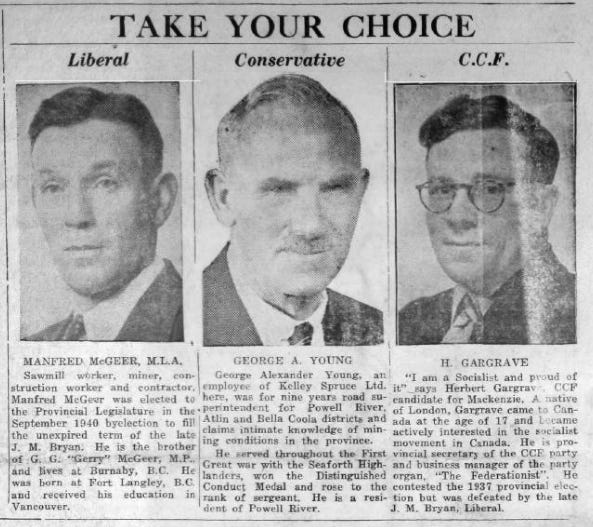
After Bakewell was Herbert Gargrave (Powell River’s MLA from 1941-49). He was the secretary of the National Painters’ Union, a member of the Socialist Party of Canada, and a founding member of the Young Socialists’ League. He was only (narrowly) defeated in 1949 when the Liberals and Conservatives formed a coalition to keep the socialists out of office.
In 1952, his younger brother Anthony Gargrave, also a socialist, was elected. He served five consecutive terms and represented the people of Powell River until 1966.
These are the people who put their heart and soul into Dwight Hall.
They would understand the crises of homelessness and addiction we’re facing today as the inevitable result of unregulated capitalism. They would know that the only solution is for working people to band together and fight for a more just world. It’s a safe bet they’d be stoked on using Dwight Hall to help the community’s most vulnerable survive another winter.
Nice work. I was at that council meeting, and it was hot and smelly and did not feel safe. People were yelling and swearing and laughing but not in a good way. That first quote in the article was yelled by a lady who repeatedly told someone to “go back where you came from”.
Excellent article 👏